


Fragrance is one of the first things a consumer notices about a personal care product.
But choosing a fragrance isn't about picking a scent you like. Source, product positioning, formula compatibility, stability, and cost all come into it.
This is how we approach fragrance in product development: how to tell the types apart, how to choose a direction, and what can go wrong once it's in the formula.
Three Types: Essential Oil, Fragrance Oil, and Essential Oil Blend
These three terms get used interchangeably. They're not the same thing.
Essential Oil
Essential oils are volatile aromatic substances extracted from flowers, leaves, peel, roots, or bark, usually by steam distillation or cold pressing. Common examples: lavender, sweet orange, peppermint, tea tree, rosemary.
The plant source is clear. But scent and composition shift with origin, climate, harvest time, and extraction method. Batches vary.
Natural doesn't mean safer. Lavender oil contains linalool. Citrus oils contain limonene. Both are regulated fragrance allergens. Essential oils need the same safety assessment and the same allergen labelling as any fragrance.
Fragrance Oil
A fragrance oil is a blend of aromatic materials built to create a specific scent. It can be all natural, all synthetic, or a mix of both.
Its biggest advantage is flexibility. A perfumer can create scents that don't exist in nature — cotton, ocean, vanilla cream — or adjust a natural one. A fragrance can also be developed for a specific formula system.
Essential Oil Blend
An essential oil blend is essential oils diluted in vegetable oil. Lavender, sweet orange, and bergamot in a carrier oil, for example.
Common carrier oils:
Soybean oil. Sunflower oil. Fractionated coconut oil (MCT / Caprylic/Capric Triglyceride). Sweet almond oil. Jojoba oil. Grapeseed oil.
Essential oils are expensive. Vegetable oil is cheap. The more carrier oil, the lower the price per kilo.
If it's diluted with a solvent like DPG instead, or contains synthetic aroma materials, it's a fragrance oil. It just has a different name.
A lot of buyers treat a blend as an essential oil, or as a cheaper substitute for one. "Essential Oil" is in the name. The price is a fraction of a single essential oil. It looks like a good deal.
It's cheaper per kilo. Not necessarily cheaper in use. Carrier oil adds no scent. A blend that's only 30% essential oil needs more than three times the dosage to deliver the same amount of essential oil. Once you work it out per kilo of finished product, the saving may be gone (more on that in the cost section below).
One more thing. Soybean and sunflower oil are highly unsaturated and oxidize easily. A blend that sits too long can go rancid, and take the product's scent with it.
So don't buy on name and unit price. Ask two questions: how much of it is essential oil, and which vegetable oil is it in?
How the Three Compare

Essential oils and fragrance oils don't replace each other. Which one fits depends on positioning, target scent, formula requirements, and cost.
How to Choose a Fragrance for Your Product
Almost every client asks the same thing: what are your best-selling scents?
We could send a list of several hundred fragrances. It wouldn't help. The longer the list, the harder the decision.
We work with fragrance houses that develop custom scents. So the list isn't the useful part. Knowing your brand and your consumer is.
Start With the Target Consumer
These are common directions. Use them as a starting point:
These aren't rules. Brand style, regional culture, and product type all change the answer.
Children's products need a separate note. Sweet scents are popular, but young skin is more sensitive. For products aimed at children under three, the safety assessment is stricter, and many brands go fragrance-free or cut the fragrance level right down.
Fragrance Families
If a client has no clear idea yet, fragrance families are a good place to start:
Fragrance families aren't a strict scientific classification. One fragrance can be floral, fruity, and woody at the same time.
Top notes, heart notes, and base notes describe how a scent changes over time. Top notes are what you smell first. Heart notes are the main character. Base notes are what stays.

Most clients want a fragrance that lasts. In a perfume, that's down to the base notes. In a body wash or shampoo, it works differently. There are two stages:
During use. The scent released while lathering. This is what the consumer smells in the shower.
After rinsing. The scent left on skin or hair.
The two often don't match. Some fragrances smell strong in the lather and disappear after rinsing. Some do the opposite. Before choosing, decide which stage your product needs to win.
Is There Such a Thing as a Best-Selling Scent?
Clients often ask:
What are your best-selling fragrances?
Which scents are popular in the market?
Can you recommend some trending fragrances?
Fair questions. But there's no single scent that sells across every product and every market.
Lavender works in a bedtime bath product. It also works in a body lotion and a shampoo. Each of those has a different consumer, a different use, and a different sales channel.
Before choosing a fragrance, answer four questions:
1. Product type. What are you developing?
2. Target customer. Who is it for?
3. Price positioning. Where does it sit, and at what price?
4. Desired experience. What should the consumer feel when they smell it?
Take the same scent direction. A mass-market body wash and a premium body butter may need completely different fragrance solutions.
So we don't hand out a bestseller list. We recommend a direction that fits your product.
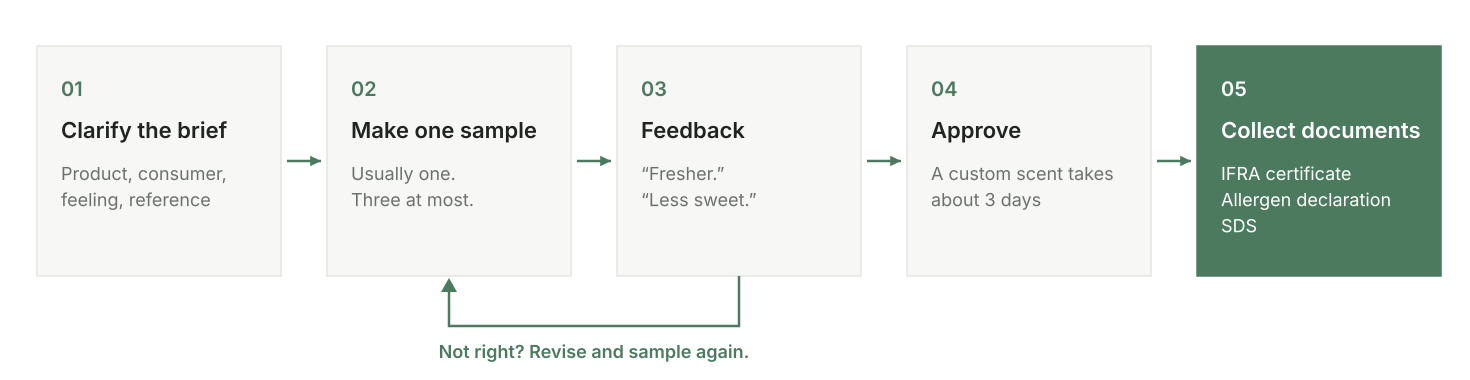
How We Actually Develop a Fragrance
Ask first. Sample second.
We don't open with three samples to choose from. We start by finding out what the client actually needs: what product, for whom, what feeling, and whether there's a reference scent or product.
Sampling blind looks efficient. If the direction is wrong, the number of samples doesn't matter.
Usually one sample.
Once the direction is clear, we make one to three samples. Most of the time, just one.
If the brief is clear, one is enough. More options often just mean more hesitation between scents that are nearly the same.
Not right? We revise.
The client smells the sample and gives feedback. "Fresher." "Less sweet." We adjust and sample again. That's faster and more accurate than starting with a pile of samples.
A custom fragrance takes about three days.
The fragrance house usually needs around three days for a custom scent. The real time goes into agreeing the direction, not into the perfumery.
Fragrance MOQ is usually 25 kg.
This one gets overlooked. A fragrance house's standard minimum order is 25 kg. For long-term partner factories, or common fragrances, 5 kg is often possible.
On a small order, that matters. Say you're making 2,000 bottles of 250 ml body wash. That's about 500 kg of finished product. At 0.3% fragrance, you need 1.5 kg. If the MOQ is 25 kg, the other 23.5 kg sits in the warehouse. Fragrance has a shelf life. Left too long, the scent changes.
So on a small first order, a standard fragrance or an existing one is often the better deal than a brand-new custom scent. For more on how minimums work, see MOQ: Where Does It Come From, and How Do You Make It Work for You?
Fragrance documents: IFRA certificate, allergen declaration, SDS.
Once the fragrance is chosen, we get three documents from the fragrance house:
IFRA certificate. Confirms the fragrance meets IFRA Standards for the relevant product category.
Allergen declaration. Lists the regulated allergens in the fragrance and their levels, for labelling and safety assessment of the finished product.
SDS. The safety data sheet for the fragrance as a raw material.
Some clients ask for the fragrance's full composition. Honestly, you won't get it. A fragrance formula is the fragrance house's core asset. For technical and commercial reasons, no fragrance house hands over a detailed, complete composition. At most, you get approximate ranges.
For compliance, that's enough. What the safety assessment and the label need is already covered by the IFRA certificate and the allergen declaration.
How Fragrance Behaves in a Formula
The right scent doesn't guarantee the right fit.
A fragrance is a complex mixture of aromatic materials. Its physical and chemical properties decide how it behaves in each formula system. More on that in A Cosmetic Formula Is a System.
Water-Soluble or Oil-Soluble
Start with whether the fragrance suits the formula system.
Oil-soluble fragrance. For oil-based systems: body oils, massage oils, some anhydrous balms.
Water-soluble / water-dispersible fragrance. For water-based systems with suitable solubilization.
"Water-soluble" doesn't mean every aromatic component actually dissolves in water. Many are dispersed with the help of solvents or solubilizers.
For body wash, shampoo, and body lotion, the surfactant system, emulsion system, and other ingredients all have to be tested together.
The supplier's water-soluble or oil-soluble label is a starting point. Not a conclusion.
Common Problems
Fragrances containing vanillin can slowly turn some products yellow, or even brown.
A fragrance smells great on its own. Added to a clear body wash, it goes cloudy. That doesn't necessarily mean the fragrance is poor quality. More likely, it just doesn't suit that formula.
So judge a fragrance in the finished product, not as a raw material. For how stability testing works, see Cosmetic Testing Before Production.
Is More Fragrance Better?
No.
The dosage has to balance intensity, product type, user experience, stability, and safety limits.
Double the dosage, and the consumer doesn't smell double the fragrance. You do get more stability risk and more cost.
Typical dosages vary a lot by product:
A body mist sells on scent, so the dosage is far higher. A facial cleanser is about mildness, so fragrance is kept low, or left out.
Set the dosage by how the finished product actually performs.
How Do You Make a Scent Last?
Almost every client wants the scent to stay after washing. Several things affect that. The biggest one is the base notes.
Base notes do most of the work. Woody, musk, amber, and vanilla materials evaporate slowly and stay on the skin. Citrus top notes evaporate fast and are gone in minutes. If you want a scent that lasts, the fragrance needs enough base notes.
The catch: slow-evaporating base materials are usually more expensive. The more base notes, the higher the fragrance price tends to be. Longevity and cost usually have to be weighed together.
Product type. Leave-on products stay on the skin, so they hold scent longer than rinse-off. Most of the fragrance in a body wash goes down the drain. A body wash won't last like a perfume. Set expectations by product type.
Formula. Oils and emollients help hold scent on the skin. The stronger the surfactant system, the cleaner the rinse, and the more scent goes with it.
Dosage. More fragrance helps a little, but not in proportion, as covered above.
Fragrance microcapsules. A lot of factories recommend this one. The fragrance is enclosed in microcapsules that break under friction, so the scent comes back when the skin is rubbed after washing. Watch the regulation, though. In the EU, microcapsules made from synthetic polymers count as microplastics under Commission Regulation (EU) 2023/2055. Fragrance encapsulation of that kind is restricted from 17 October 2029. If a product in development is heading for the EU, confirm the capsule material early.
So a lasting scent is rarely just a matter of adding more fragrance. It usually takes a few things together: a fragrance with more base notes, a formula that holds it on the skin, and sometimes microcapsules. Each one adds cost.
Three Priorities, in Order
1. Safety. The fragrance has to meet the regulatory and safety requirements of the target market. That's the baseline.
2. Stability. The fragrance has to be compatible with the formula and keep the product stable under reasonable storage conditions.
3. Scent performance. Once the first two are met, optimize intensity, character, and longevity.
The order doesn't flip.
Cost and Regulation
Purchase Price Isn't Cost in Use
Two fragrances that smell alike can be priced very differently. What drives the price:
Raw materials. Natural and synthetic materials cost differently, and natural materials vary widely among themselves.
Composition. How complex the fragrance formula is.
Solvent. How much solvent is in it, and which one.
Performance. Special scent effects or long-lasting performance usually need more expensive materials.
More solvent, lower price. Most fragrances contain some solvent, to dilute the aroma materials and adjust concentration. Same fragrance, more solvent: the aromatic share drops, and so does the price per kilo. So does the scent. To get the same effect, you have to use more of it in the product. It's the same logic as an essential oil blend with more carrier oil.
Which solvent matters too. Solvent prices vary a lot. DPG (dipropylene glycol) is cheap. MMB (3-methoxy-3-methyl-1-butanol) costs much more. Two fragrances with similar scents and the same solvent share can still be priced quite differently. A solvent isn't just filler. It affects solubility, odor, and how the fragrance behaves in the formula.
An example. Fragrance A costs $20/kg and needs 0.6% to reach the target scent. Fragrance B costs $40/kg and only needs 0.3%. Per kilo of finished product, both cost $0.12.
So compare cost in use. When a fragrance looks very cheap, ask: how much of it is solvent, and which solvent?
And remember the MOQ. Fragrance you never use is still a cost.
A more expensive fragrance doesn't automatically make a better product. What matters is whether it delivers the scent you need at a reasonable cost.
Safety and Regulation
Three things to check during development:
IFRA Standards. Confirm the fragrance meets the IFRA restrictions for the product category.
Fragrance allergens. Identify the regulated allergens in the fragrance and label them as the target market requires.
Regional regulations. Confirm the fragrance and its components comply with the cosmetics rules of the target market.
Two common misunderstandings:
IFRA doesn't issue IFRA certificates. The fragrance supplier does. The certificate confirms that a specific fragrance meets IFRA Standards for a specific use category. It doesn't replace the safety assessment of the finished product. In the EU, that's the job of the CPSR. See CPNP, PIF, CPSR: EU Cosmetic Registration.
Essential oils need safety assessment too. A natural source doesn't exempt anything from use restrictions.
The EU's new allergen labelling rules. Under Commission Regulation (EU) 2023/1545, the EU added 56 fragrance allergens to the list that must be labelled individually, bringing the total to more than 80. The rule has applied since 31 July 2026 to products newly placed on the EU market. Products already on the market before that date can stay on sale until 31 July 2028. The thresholds haven't changed: above 0.001% in leave-on products, or 0.01% in rinse-off, the allergen has to appear on the ingredient list by name. Why buyer lists often go further than this, we covered in Why Minimal Formulas Are Gaining Ground.
So changing a fragrance isn't just changing a scent. Stability has to be rechecked. The allergen declaration has to be rechecked. The label may have to change. Tedious, but unavoidable. More in Cosmetic Compliance: From Formula to Market.
Closing
Choosing a fragrance is only one part of developing a product. What matters is that the scent fits the positioning, the consumer, and the formula.
You don't need to know perfumery. Tell us what you're making and how it should feel. We'll narrow it down from there.
Not sure where to start? The tool below turns your answers into a fragrance brief in a few minutes. Send it straight to us.