
When we first look at a cosmetic formula, what usually stands out is an ingredient list: water, glycerin, surfactant, emulsifier, thickener, preservative, fragrance, and a few ingredients with marketing appeal.
It's easy to assume that formulation is just picking the right ingredients, then deciding how much of each to add.
The reality is more complex. A product's viscosity, foam, skin feel, stability, preservation — even its appearance — are rarely decided by one ingredient alone. They come from the whole formula system working together.
Raise the humectant level, and hydration may improve — but so might stickiness. Change the surfactant, and cleansing power and foam may shift, along with the thickening you already had. Adjust pH for one active ingredient, and the preservative system may quietly lose effectiveness.
So instead of thinking of a formula as an ingredient list, it helps to think of it as a system: different parts working together, each with a main job — but rarely just one job. Understanding this is the starting point for understanding cosmetic formulation.
1. A Formula Starts With Defining the Product
Before we talk about specific ingredients, there's a more basic question. Not "what ingredients should we add?" This looks like a basic question — but it decides everything that follows.
What does the product need to do? A cleanser and a moisturizer need different formula systems. Even within cleansing products, a facial cleanser, a body wash, and a shampoo have different requirements for cleansing power, foam, conditioning, and rinse feel. The product's core function is the first condition for building a formula system.
How will the product be used? A basic distinction is how long the product stays on skin or hair.
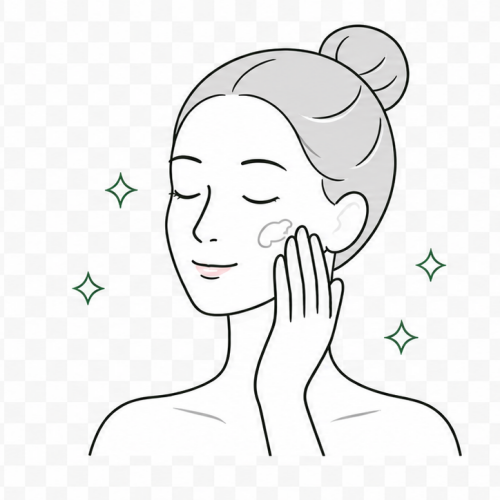
Rinse-Off. Face wash, body wash, shampoo. These stay on skin or hair briefly before being rinsed away. Cleansing power, foam, rinse feel, and post-rinse skin feel are usually the main design priorities.
Leave-On. Serums, lotions, creams. These stay on skin for hours, sometimes all day. The priorities shift: skin feel, stability, preservation, active compatibility, and long-term comfort all matter more.
Wipe-Off. Some makeup removers and cleansing products. Not rinsed away like a typical rinse-off product, but also not left on skin the way a cream is — which creates its own requirements.
| Factor | Rinse-off | Leave-on | Wipe-off |
|---|---|---|---|
| Use |
 Rinse-off
Products that are rinsed off with water after a short time. |
 Leave-on
Products that remain on the skin or hair for hours or all day. |
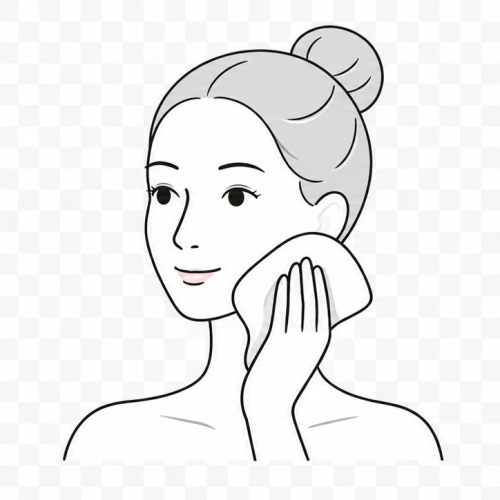 Wipe-off
Products that are removed by wiping, not rinsed with plenty of water. |
| Examples | Cleansers, body wash, shampoo | Serums, lotions, creams | Micellar water, some cleansing wipes |
| Contact time | Under a minute | Hours to all day | A few minutes |
| Preservative demand |
Moderate Short contact time with lower water retention |
High Long contact time and higher water retention |
High Contact with face/skin without rinsing |
| Fragrance restriction |
Relatively relaxed Washed off quickly, lower irritation concern |
Strict Long-lasting contact, higher irritation potential |
Strict Direct contact with skin, irritation risk during wiping |
What form and experience should the product deliver? Even with the same function, a product can take very different forms. A leave-on moisturizer, for example, can be a fast-flowing serum, a light lotion, a rich cream, or an almost water-free balm. A cleanser can aim for rich foam, low foam, a clear gel, a lotion-like texture, or an oil-to-milk experience. These differences aren't decoration added after development — they're part of formulation itself.
So before choosing ingredients, we need answers to: what does the product need to do, how will it be used, what form should it take, and what experience should the consumer get? Only once these are set can we start deciding what formula system to build.
2. Understand Formula Type Before Formula Architecture
Not every cosmetic product is built on the same foundation. A cream and a body wash may both contain water, glycerin, fragrance, and preservative — but their underlying structures can be completely different.
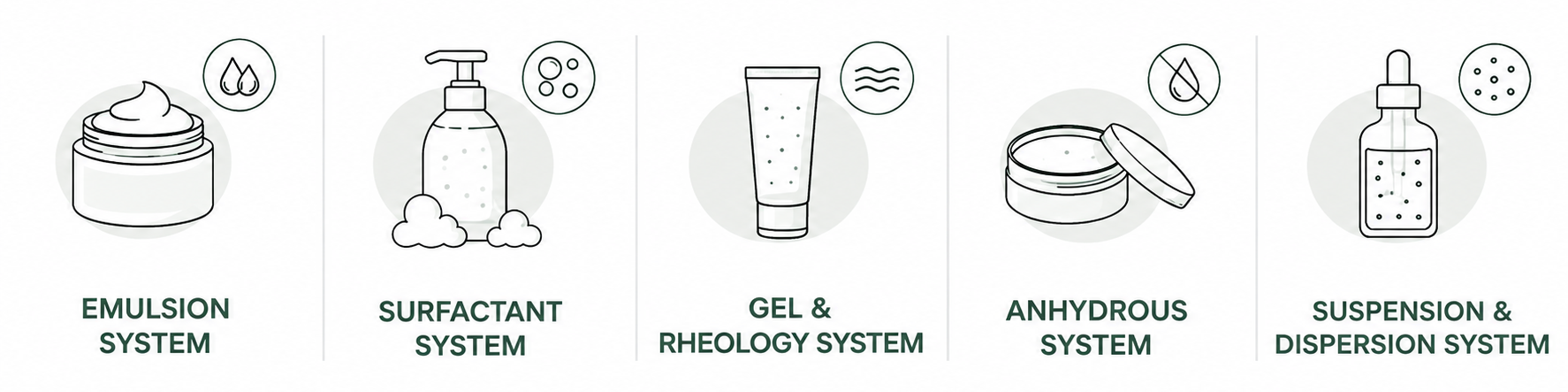
Emulsion System. Common in lotions and creams. It needs to hold water and oil — two phases that don't naturally mix — in a stable structure. Oil phase composition, emulsifier choice, thickening structure, and how other ingredients interact all matter here.
Surfactant System. Common in facial cleansers, body wash, and shampoo. The core usually isn't one surfactant — it's several surfactants working with thickening and conditioning ingredients as a system. Together they decide cleansing power, foam, mildness, viscosity, and rinse feel.
Gel / Rheology System. Common in gels, some serums, and other products that rely on rheology for their texture. A thickener doesn't just decide "how thick." Different rheology systems can also affect flow behavior, suspension ability, spreadability, clarity, and how the product feels during use.
Anhydrous System. Some balms, oils, and sticks. No water doesn't mean a simpler formula. Oils, waxes, structuring agents, and other oil-soluble ingredients still need to form the right structure, with melting point, hardness, spreadability, and long-term stability all in play.
Suspension / Dispersion System. When a formula contains particles, powders, or colorants that don't truly dissolve, the challenge isn't just "adding them in." Keeping them evenly dispersed, preventing settling or clumping, and maintaining the right feel is itself part of system design.
These categories aren't meant to put a single label on every product — a real product can involve more than one type. What they really help us understand is this: different products start from different foundational structures, and only then does it make sense to talk about specific ingredients.
3. A Formula Can Be Understood as Five Connected Layers
Formula Type tells us what kind of system this is. Next we need to understand how that system is built inside.
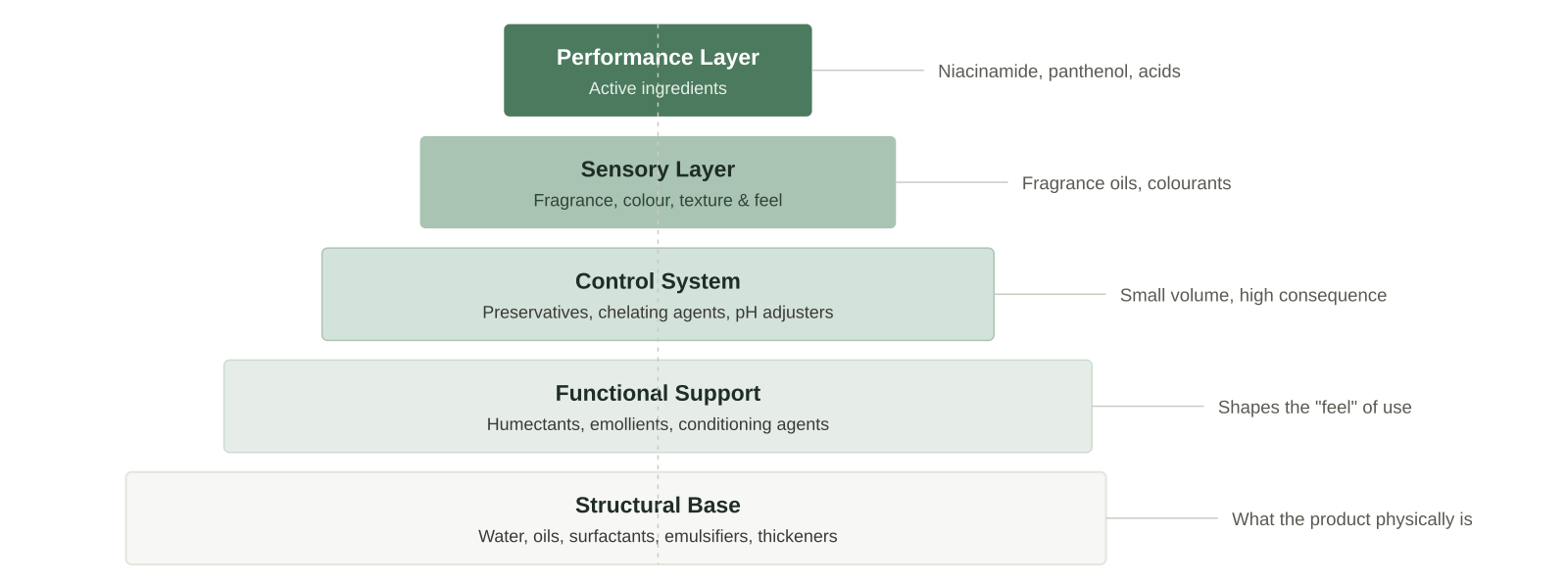
Different products vary a lot, but stepping back from any single product, a typical liquid personal care formula can be understood through a few basic layers. These aren't strict chemical categories — they're a way to make the structure easier to see.
Layer 1: Structural Base. This is the foundation the whole formula stands on. It may include water, oils, surfactants, emulsifiers, and thickeners. Different products build this layer differently — a cleanser might center on water and surfactant, a lotion needs a stable oil-water emulsion, a gel depends heavily on its thickening system. This layer largely decides what the product actually is: a thin, flowing liquid, a clear gel, a light lotion, or a heavy cream — that starts with the structural base, not with how many "hero ingredients" sit on top of it.
Layer 2: Functional Support. On top of the base, some ingredients help the product perform the way it's supposed to: humectants (like glycerin, sorbitol) hold moisture; emollients (some oils and silicones) improve skin feel; conditioning agents improve how skin or hair feels during use. These aren't always the most talked-about ingredients, but they shape how the product actually feels to use. Raise the glycerin level and hydration may improve — and so may stickiness. Add more emollient for a softer feel, and foam in some cleansing systems may drop. Functional support is a balancing act, not a simple addition.
Layer 3: Control System. Some ingredients get little attention from consumers, but they're essential for a formula that can actually go to market: preservatives, chelating agents, pH adjusters, antioxidants where relevant. They control microbial risk, oxidation, pH, and overall stability. Take pH — it looks like just one number on a spec sheet. But it can affect active ingredient stability, preservative effectiveness, thickening behavior, and the whole feel of the product at once. This layer isn't just "supporting" — it's what keeps the rest of the system working properly.
Layer 4: Sensory Layer. Once a product is stable and functional, there's still the question of what it feels like to use: scent, color, flow, spreadability, freshness or richness, and how it feels after use. Fragrance and color are the easiest sensory factors to spot, but sensory experience isn't only about those two. The thickening system changes how the product moves in your hand. Oils change spreadability and after-feel. Humectants can add softness — or stickiness. Surfactant systems shape foam size, richness, and rinse feel. The "texture" a consumer notices is really the combined result of several layers working together.
Layer 5: Performance Layer. This is usually the layer that gets the most attention from brands and consumers alike: active ingredients — niacinamide, panthenol, various acids, and other ingredients with a clear functional positioning. These matter; they often drive a product's core claims. But here's what's easy to overlook: the most marketed ingredient is still built on top of a much larger system. If the structural base isn't stable, the preservation system isn't right, the pH isn't compatible, or the active can't stay stable in the system, simply raising the active percentage won't automatically give you a better product.
4. Formulation Is About Interactions, Not Isolated Ingredients
If a formula were just a set of unrelated modules, development would be a lot simpler. The real challenge is that they influence each other. This is why we prefer the term "formulation system" over "ingredient list."
Surfactant ↔ Thickener. Surfactants drive cleansing and foam — but they also affect viscosity. Changing a surfactant can noticeably change a product's thickness, even if the thickener amount hasn't changed at all.
Emollient ↔ Emulsifier. Changing an oil isn't just about richness. Once the oil phase changes, whether the existing emulsifier system can still hold everything stable needs to be checked again.
Humectant ↔ Texture. Raising glycerin, or a similar humectant, can improve hydration — but it can also change viscosity, spreadability, and stickiness. "More moisturizing" is never just a matter of raising one percentage.
pH ↔ Preservative ↔ Active Ingredient. This might be the clearest example. Some active ingredients need a specific pH range to work. But adjusting pH for that active can affect whether the preservative system still works — and whether the thickening system and other ingredients are still compatible.
So the real question in formula development isn't "what does this ingredient do?" It's: "if this ingredient changes, what else changes with it?"
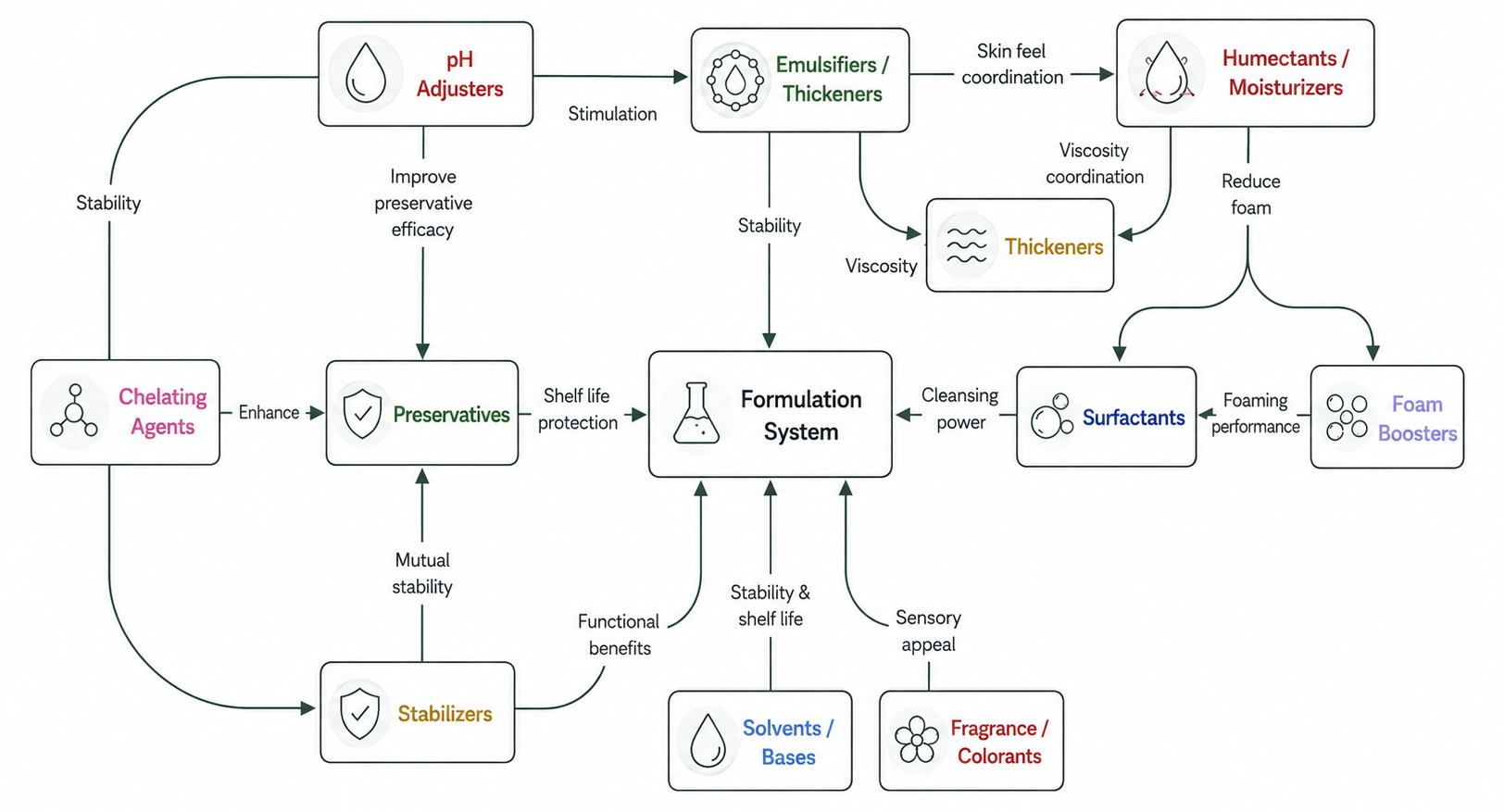
This is the most important thing to understand about a formulation system: every ingredient has a main function, but its effect on the system is rarely limited to just one thing.
5. Every Formula Involves Trade-Offs
Once we understand how ingredients interact, another fact becomes clear: formulation is rarely about adding more in a single direction. Often, improving one property changes another.
So a lot of formula requirements don't have a simple "more is better" answer. More foam doesn't automatically mean better cleansing. Higher viscosity doesn't automatically mean a more premium texture. More oil doesn't automatically mean better hydration. A higher active percentage doesn't automatically mean a better formula.
Real formulation work is closer to finding a reasonable balance across several goals at once. Performance, sensory experience, stability, mildness, and compatibility all need to coexist in the same system. This is also why two formulas with a very similar INCI list can still perform quite differently — what actually defines a product isn't only what's used, but how much, in what combination, and how those parts work together.
6. Why "Just Changing One Ingredient" Is Rarely a Small Change
In OEM/ODM development, we get requests that sound simple all the time.
"Can we remove phenoxyethanol?" On the INCI list, this looks like deleting one line. But the real question is: does the preservative system need to be redesigned? What pH does the new system need? Is it compatible with the other ingredients already in the formula? Will the final product still pass microbial and preservation testing?
"Can we increase this active from 2% to 5%?" This isn't just changing a number on a spec sheet. As active concentration goes up, we may need to re-check solubility, pH compatibility, system stability, viscosity, skin feel — and final product cost.
"Can we make it thicker?" Adding more thickener seems like the obvious fix. But viscosity is also shaped by the surfactant system, electrolytes, pH, the oil phase, and even production conditions. Simply adding more of one thickener doesn't always get the result you're expecting.
This is why a change that looks small on paper can trigger two or three related adjustments — and often means a new round of samples. In formula development, the question we ask is rarely just "can we add this?" It's: "once we add it, what else moves?"
7. Stability Isn't a Problem You Solve After the Formula Is Done
A sample that looks good, has the right viscosity, and feels great in the lab the day it's made doesn't mean the formula has actually succeeded. A working formula system also needs to hold its state over time.
Stability here isn't only about whether a product separates. It covers a few different levels.
Physical Stability. Does the emulsion separate? Do suspended particles settle too fast? Does viscosity shift noticeably? Does a gel structure change over time?
Chemical Stability. Some ingredients change with time, temperature, light, oxidation, or pH. An active ingredient being "in the formula" and an active ingredient "staying in a usable state within the formula" are two different questions.
Microbiological Stability. In water-based systems, a preservative doesn't work alone. pH, formula composition, raw material characteristics, and other factors all affect how well the whole preservation system performs.
So stability isn't a separate test bolted onto formulation after the fact — it's part of how we judge whether a formula system actually works. How to design a stability test, a compatibility test, or a challenge test is its own, deeper topic — we cover the reasoning behind it in How We Think About Preservation: A Multi-Hurdle Approach to Formulation Safety.
8. Once the Formula System Is Set, the Next Step Is Making It
When formula architecture is set, the next step is turning these ingredients into an actual product. In practice, this involves phase separation, heating, emulsification, homogenizing, cooling, and adding active ingredients, fragrance, preservatives, and other components at the right stage. That's a different topic.
Here it helps to separate two things that often get blurred together: formula decides what needs to work together; process decides how to actually make that happen. The same formula, run with a different addition order, temperature, shear, or homogenizing condition, can produce a different result. Formulation and manufacturing process are closely related, but they aren't the same question.
We've already covered the full production process, from weighing raw materials through emulsification to filling, in How a Liquid Cosmetic Formula Becomes a Finished Product, so we won't repeat it here.
9. How Should a Brand Evaluate a Formula?
A consumer usually only sees an INCI list. A brand sees more information during development — but it's easy to fall into the same ingredient-list thinking anyway: Does it have niacinamide? Is the active at 2% or 5%? Does it include a trending plant extract? Are there enough ingredients? Can we drop something that looks "not clean enough"?
These questions aren't meaningless. But if they're the only lens used to judge a formula, it's easy to miss what actually decides how a product performs. When you're looking at a formula, these are the questions worth asking instead.
Formula Evaluation Checklist
Questions worth asking before you sign off on a formula.
1. Structure
- What is the structural base — emulsion, surfactant system, gel, anhydrous, or suspension?
- Does that base match the texture and form you actually asked for?
2. Performance Drivers
- Where do the foam, texture, and hydration actually come from — which layer?
- Is the active ingredient built on a stable base, or added on top of one that isn't resolved?
3. Interactions
- Does the pH work for both the active ingredient and the preservative system?
- If the oil phase changed, has emulsion stability been re-checked?
4. Trade-offs
- What is this formula optimized for — lightweight or rich? Rich lather or mild cleansing?
- Is there a stated trade-off, or is "more of everything" being promised?
5. Change Impact
- If we change one ingredient, what does the manufacturer say needs to be re-checked?
- Does "yes, we can do that" come with a retest plan — or is it treated as a one-line edit?
Many of these questions don't have one correct answer. They depend on what the product is actually meant to achieve. But the most useful question, more often than not, is the last one on that list: if we change this, what else might need to change?
Conclusion — Formulate the System, Not the Ingredient List
What a consumer eventually sees is an INCI list. What a product development team should see is the entire system behind that list.
Surfactants clean — but they also affect foam and viscosity. Oils improve skin feel — but they can affect emulsion stability. Humectants add moisture — but they can also change texture. pH can touch active ingredient performance, preservative effectiveness, and overall stability, all at once.
And the active ingredients at the top of the system only matter if everything underneath is actually working.
So a good cosmetic formula isn't defined by how many "hero ingredients" it contains, and a higher active percentage doesn't automatically mean a better product. What actually matters is whether the whole system works together.
That's why, in product development, the question we care about isn't only "What's in the formula?" It's also: "How does the formula work as a system?"
Once you look at formulation this way, an ingredient list stops being just a collection of separate items. It starts to look like a map. And real formulation happens in the relationships behind that map.
Disclaimer: This article describes general formulation principles for reference only. Specific ingredient interactions, concentration limits, and regulatory requirements vary by product type, target market, and raw material batch, and should be validated for each project.
Curious how we approach formula development? See our formulation approach, or get in touch to start a project.