


Most people assume a bath bomb floats or sinks by chance. It doesn't. Floating and sinking can be designed in advance, through formula and process. It just rarely comes up during product development.
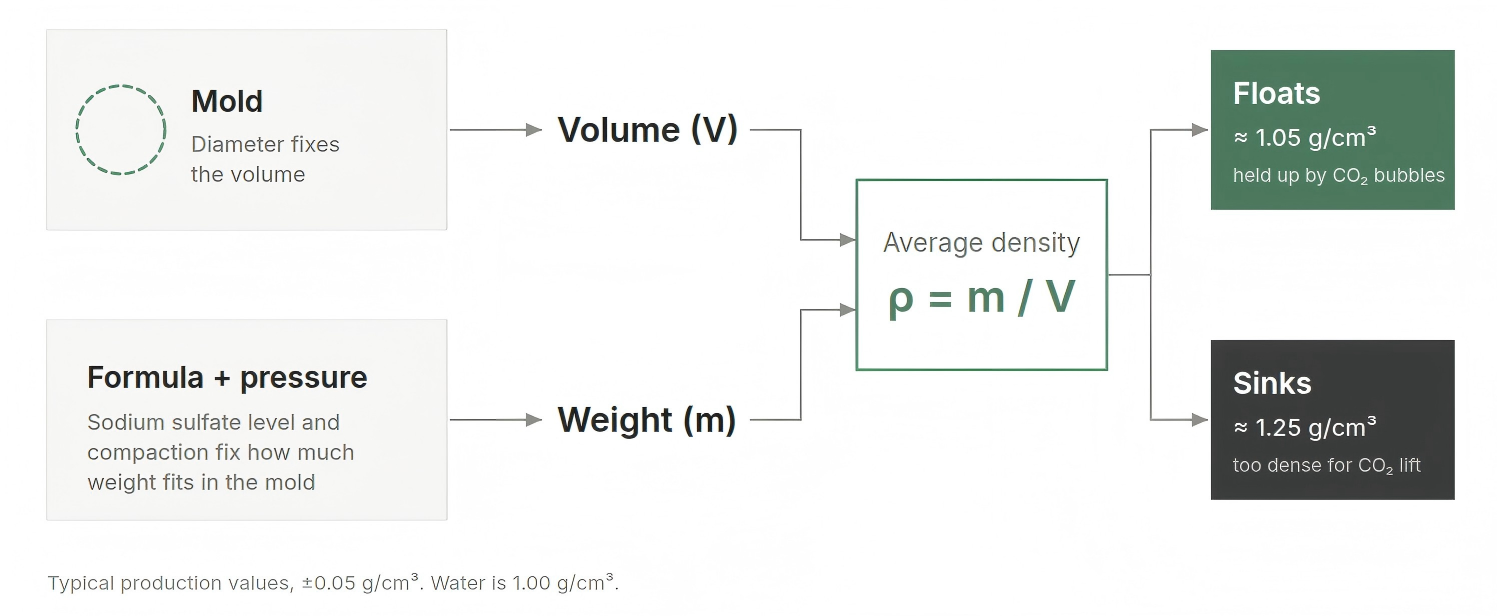
The deciding factor is one number: the average density of the finished product.
Put simply: at the same weight, a bigger bath bomb is more likely to float. At the same size, a heavier one is more likely to sink. But to understand why the same weight can become either a floater or a sinker, you have to look at weight, size, formula, and process together.
It Comes Down to Average Density
The formula is simple:
ρ = m / V
ρ is density, m is weight, V is volume. For a sphere, volume is roughly V = 4/3 × π × r³.
Water has a density of about 1 g/cm³. Basic physics says anything less dense than water floats, and anything denser sinks.
But a bath bomb isn't a static object. The moment it hits the water, sodium bicarbonate and citric acid start reacting. The CO₂ bubbles cling to its surface and add lift. That's why, in real production, a floating bath bomb is actually slightly denser than water: around 1.05 g/cm³. It floats because the reaction holds it up. Push the density higher, and the bubbles can't keep up. Then it sinks.
The key point: weight alone tells you nothing. You need volume too.
And volume is less intuitive than it looks. It scales with the cube of the radius, so a small change in diameter makes a big change in volume. Shrink the diameter by 5%, and volume drops by about 15%. With bath bombs, a few millimetres can decide whether it floats or sinks.
The Mold Sets the Volume. Formula and Pressure Set the Weight.
This is the key to the whole question.
In production, size is fixed by the mold. Choose the mold, and the volume is essentially decided. What the formula and pressing pressure decide is how much weight goes into that mold. Divide one by the other, and you get the final density.
So there are really only two ways to change whether a bath bomb floats or sinks:
Change the fill. Put more or less material into the same mold.
Change the mold. Go bigger or smaller.
Sodium sulfate and pressing pressure, covered next, both work through the first route.
Sodium Sulfate Sets the Density Baseline
Sodium sulfate is a common filler in bath bomb formulas. It's relatively heavy. The more of it in the formula, the heavier and denser the mix.
In our production experience, keeping sodium sulfate below about 5% makes it fairly easy to reach a floating product through formula structure and pressing conditions. Go clearly above 5%, and the product leans noticeably toward sinking.
That 5% is a production reference, not a hard line. Sodium sulfate can't be judged apart from pressing pressure:
Low sodium sulfate + low pressure: usually floats.
Low sodium sulfate + high pressure: can still sink if packed too tight.
High sodium sulfate + low pressure: the middle ground. The result depends on fill weight.
High sodium sulfate + high pressure: the most likely to sink.
A more accurate way to put it: sodium sulfate sets the density baseline of the formula. Pressing pressure decides how tightly that formula gets packed.
Pressure Decides How Tightly It's Packed
Same formula, different pressure, different density.
More pressure means fewer gaps between particles and less trapped air. More material fits into the same mold. Average density goes up.
So even a formula low in sodium sulfate can end up dense enough to sink if the pressure goes up far enough.
If you want a floater, compaction has to be controlled, while still meeting hardness and shipping-durability requirements. But pressure can't go too low either. A loose mix crumbles and won't hold its shape.
Formula and molding parameters have to be controlled together.
The Gap Between Floating and Sinking Is Smaller Than You'd Think
From our mold and production experience:
Floating bath bombs: average density around 1.05 g/cm³.
Sinking bath bombs: average density around 1.25 g/cm³.
Production variation: about ±0.05 either way.
A floater is slightly heavier than water and still floats, thanks to the CO₂. A sinker is about 20% denser. At that point, the bubbles can't hold it up.
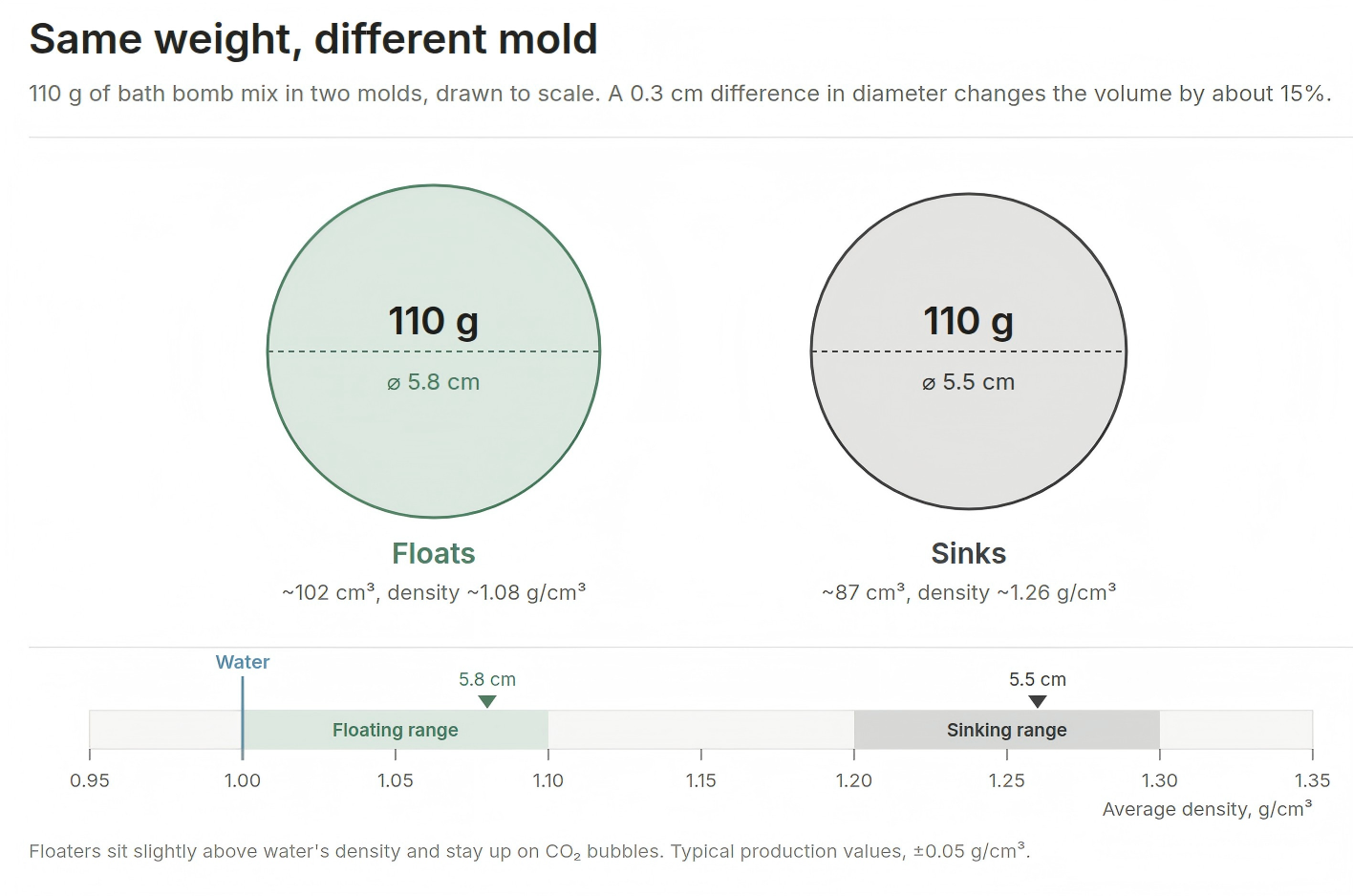
Take 110 g as an example, pressed into two different molds:
| Mold | Volume | Density (g/cm³) | Result |
|---|---|---|---|
| 5.8 cm | ~102 cm³ | ~1.08 | Floats |
| 5.5 cm | ~87 cm³ | ~1.26 | Sinks |
Same weight. Mold diameter differs by just 0.3 cm. Volume differs by about 15%. One floats, one sinks.
Now fix the mold instead. Say 6 cm:
About 120 g: average density ~1.06. It floats.
About 140 g: average density ~1.24. It sinks.
This tells you three things.
Same weight, different size. A floater and a sinker of the same weight usually aren't the same size. The sinker is typically smaller.
Floaters are the harder ones. A floating bath bomb is already heavier than water and relies on reaction bubbles to stay up. That puts more demand on formula and process consistency. Let the density drift high, and it may not float.
Small sizes are the most sensitive. The smaller the mold, the smaller the weight gap between floating and sinking. In a 3 cm mold, a floater is about 15 g and a sinker about 18 g. Roughly 3 g apart. At that size, the outcome comes down to a few grams of fill, and it's much harder to control.
When the Size Is Locked
Say a client wants a sinking bath bomb, and specifies 110 g / 5.8 cm / sinking.
From the numbers above, 110 g in a 5.8 cm mold gives a density of about 1.08. That's floater territory. To make it sink reliably, there are usually two options:
Keep 5.8 cm, and raise the weight to about 130 g.
Keep 110 g, and reduce the size to about 5.5 cm.
If neither weight nor size can move, the only levers left are formula structure and pressing method. There's far less room to work with.
Once size is fixed, weight becomes the variable that matters most.
Sinking Bath Bombs Aren't Automatically Cheaper
A common assumption: sinkers are simpler, so they should cost less. It doesn't work that way. It depends on whether the weight changed, and whether the size changed.
| Type | Weight / size | Result | Relative cost |
|---|---|---|---|
| A | 110 g / 5.8 cm | Floats | Baseline |
| B | 110 g / 5.5 cm | Sinks | Usually lower |
| C | ~130 g / 5.8 cm | Sinks | Not necessarily lower |
A vs B. Both are 110 g. A uses little sodium sulfate and a looser structure. B uses more sodium sulfate, packs denser, and drops to 5.5 cm. Total weight doesn't go up, and sodium sulfate is a relatively economical filler, so B usually has some room to bring formula cost down. This is the typical case where a sinker saves money: same weight, smaller size allowed.
A vs C. Both are 5.8 cm. But C goes from 110 g to about 130 g. That's nearly 20% more material in the same size. C can use more sodium sulfate to manage formula cost, but the extra weight is real. Being a sinker doesn't make C cheaper by default. It may cost about the same as A, or more.
So when comparing floaters and sinkers on cost, one rule matters: don't just compare float with sink. Compare weight and size at the same time.
Built-in Toys Change the Math
If there's a toy inside, it counts. What decides float or sink is the average density of the whole finished product, not just the bath bomb around it.
A toy can push the product toward floating or toward sinking. It depends on three things: the density of the material, the wall thickness, and whether it's hollow or solid.
As a rough guide: PP and PE are lighter than water, ABS is close to water, PVC is noticeably heavier, and TPR varies a lot by grade. A hollow or low-density toy adds volume without adding much weight, which can lower the overall density. A solid, heavy toy raises it and makes sinking more likely.
In our experience, small TPR toys usually have little effect on the result. PVC toys often need to be accounted for at the design stage.
For a product with a built-in toy, the toy has to be designed as part of the product structure.
Why Some Bath Bombs Sink First, Then Float
As covered above, a floater floats largely because of the CO₂ it produces. The same mechanism explains what happens after it hits the water.
At first, not many bubbles have formed on the surface. A product close to the float–sink threshold may sink first, then rise as the reaction builds. Others move around while they fizz, or shift position briefly. Surfactants, oils, how quickly the surface wets, and how the bubbles attach all play a part.
These are dynamic effects in the water. If a client specifies floating or sinking, the main outcome can still be controlled through the base formula, product size, and process.
How We Confirm It in a Real Project
None of these variables means the client has to be involved in every technical decision. In practice, the conversation is much simpler.
The client confirms two things first: weight + float or sink. For example: 100 g / Floating. Or 100 g / Sinking.
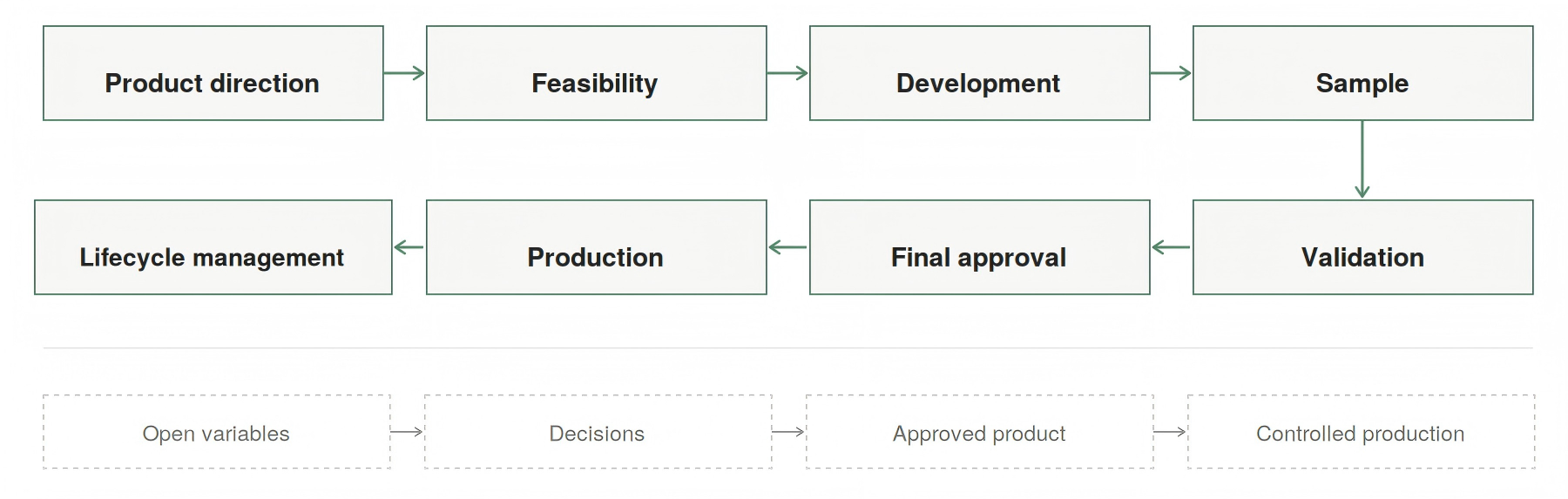
If there's no specific size requirement, we adjust mold size, sodium sulfate level, formula structure, and pressing pressure to hit the target, then confirm it with a water test at the sampling stage.
What needs extra discussion is when more conditions are locked at once: weight + sinking + a specified size, or a built-in toy on top of that. The more conditions are fixed, the less room there is to adjust. Formula structure and cost may shift as a result.
Why the Reference Numbers Don't Match One-to-One
A bath bomb is a "live" product. Even with the same formula and the same mold, final density and in-water behavior still vary. The main sources:
Raw material batches. Sodium bicarbonate and citric acid vary in particle size, so their bulk density varies. Same mold, same pressure, different fill.
Moisture in the mix and in the room. The moisture content of the powder and the humidity on the production floor affect how the mix binds and compacts.
Molds and pressing. There's a gap between nominal diameter and the actual finished piece: seam lines, flash. Pressing consistency also affects how much goes into each one.
Storage. Once a bath bomb absorbs moisture, a slow pre-reaction can start on its surface.
Bath conditions. Warmer water means a faster reaction and more bubbles. A product near the threshold floats more easily.
A floater already sits in a narrow zone: slightly heavier than water, held up by bubbles. Small changes like these are enough to tip the result.
So theory and reference tables only help set a direction early in development. What actually confirms float or sink is a water test on real samples, followed by ongoing control of raw materials, humidity, and pressure in production.
Honestly, this is where bath bombs can get frustrating for us. Same formula, same mold, and one batch behaves slightly differently from the last. The reasons are often hard to explain to a client in a sentence or two. That's part of why we wrote this: so that before a project starts, everyone shares the same understanding of this uncertainty. It makes the conversation a lot easier.
Summary
Float or sink isn't "add ingredient X and it sinks." It's about how much weight is packed into how much volume.
More sodium sulfate → higher density baseline.
More pressure → more material in the same mold.
More weight, same size → more likely to sink.
Same weight, bigger size → more likely to float.
A built-in toy → its material and structure shift the overall density further.
In most cases, all a client needs to tell us is the weight, and whether it should float or sink. Getting there through formula, size, and process, and confirming it with sample testing, is the manufacturer's job.
Reference: Bath Bomb Weight by Mold Size
The figures below are converted from our standard spherical mold sizes, using production-based density ranges of 1.00–1.10 g/cm³ for floating and 1.20–1.30 g/cm³ for sinking. They're a starting point for development, not a one-to-one standard. Actual weights shift with raw material batches, humidity, and pressing conditions. Final results should always be confirmed by a water test on samples. Products with built-in toys need separate evaluation.
| Mold diameter | Floating (ref.) | Sinking (ref.) |
|---|---|---|
| 3.0 cm | 14–16 g | 17–18 g |
| 3.2 cm | 17–19 g | 21–22 g |
| 3.5 cm | 22–25 g | 27–29 g |
| 3.8 cm | 29–32 g | 34–37 g |
| 4.2 cm | 39–43 g | 47–50 g |
| 4.5 cm | 48–52 g | 57–62 g |
| 4.7 cm | 54–60 g | 65–71 g |
| 4.8 cm | 58–64 g | 70–75 g |
| 5.0 cm | 65–70 g | 80–85 g |
| 5.1 cm | 70–75 g | 85–90 g |
| 5.2 cm | 75–80 g | 90–95 g |
| 5.4 cm | 80–90 g | 100–105 g |
| 5.5 cm | 85–95 g | 105–115 g |
| 5.8 cm | 100–110 g | 125–135 g |
| 6.0 cm | 115–125 g | 135–145 g |
| 6.2 cm | 125–135 g | 150–160 g |
| 6.3 cm | 130–145 g | 155–170 g |
| 6.4 cm | 135–150 g | 165–180 g |
| 6.5 cm | 145–160 g | 175–185 g |
| 6.7 cm | 155–175 g | 190–205 g |
| 6.8 cm | 165–180 g | 200–215 g |
| 7.0 cm | 180–200 g | 215–235 g |
| 7.2 cm | 195–215 g | 235–255 g |
| 7.5 cm | 220–245 g | 265–285 g |
Weights rounded to the nearest 1 g for molds of 4.8 cm and below, and to the nearest 5 g for 5.0 cm and above.
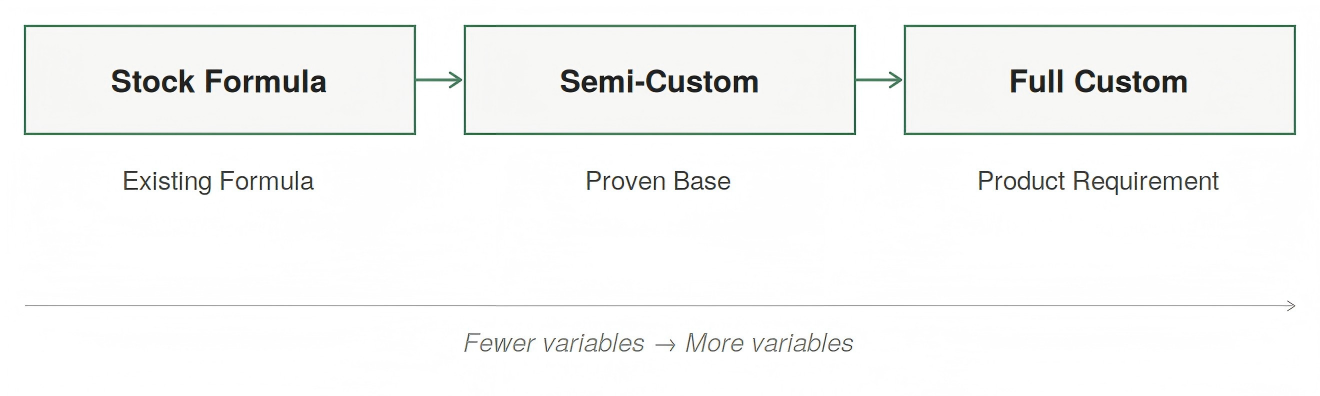
Developing a bath product and weighing float against sink? Contact us or learn more about our product development approach.
.jpeg)