
There's a question that comes up in almost every new client conversation, usually halfway through:
"What's your MOQ?"
Sometimes the line goes quiet after that. Or we get: "That's too high. Let me think about it."
MOQ is a threshold for buyers, but honestly, it's not great for suppliers either — nobody wants a potentially great partnership to fall apart over order quantities.
That's why I've always felt MOQ shouldn't just be a number on a quote sheet. When we say MOQ: 3,000 pcs, what the client sees is 3,000 units. What we're actually looking at might be: formula requires a minimum 100 kg batch, bottles can be sourced from 1,000 pcs, but direct-print packaging has a 5,000 pc minimum, and the outer box has its own number on top of that. That "3,000" is the result of fitting all of those pieces together.
So this isn't really about what a "normal" cosmetic MOQ should be. It's about where MOQ actually comes from — and what's adjustable when the number feels too high. (If you just need the quick version, it's also covered in our FAQ.)
One Product, Multiple MOQs
Say we're developing a 50ml face cream. The client asks: "Can you do 2,000 units?"
We don't answer straight away. We look at it piece by piece.
Formula: minimum batch is 100 kg. At 50ml per unit, 2,000 units is about right. No issue.
Bottle: client picks a standard PET bottle. Supplier can ship from 1,000 pcs. Fine.
Logo printing: client wants the logo printed directly on the bottle. The printer comes back with a 3,000 pc MOQ.
So — is this product a 2,000 MOQ or a 3,000 MOQ? The answer depends on what gets decided next: produce 3,000 finished units; produce 2,000 now and hold the remaining packaging for the next run; skip direct print and go with a label instead; or revisit the packaging choice entirely.
This is why when someone asks "What's your MOQ?" it's genuinely hard to answer before the product is defined. In many cases, we don't know yet either.
The Packaging Usually Drives MOQ More Than the Equipment
Most people assume factory MOQ is mainly about production line capacity. And yes, equipment does have a minimum viable batch — an emulsification vessel running a water-and-oil system needs enough product in it to mix properly. You can't run a 500 kg emulsifier at 5% capacity and expect consistent results.
But in practice, what pushes MOQ up most often is packaging.
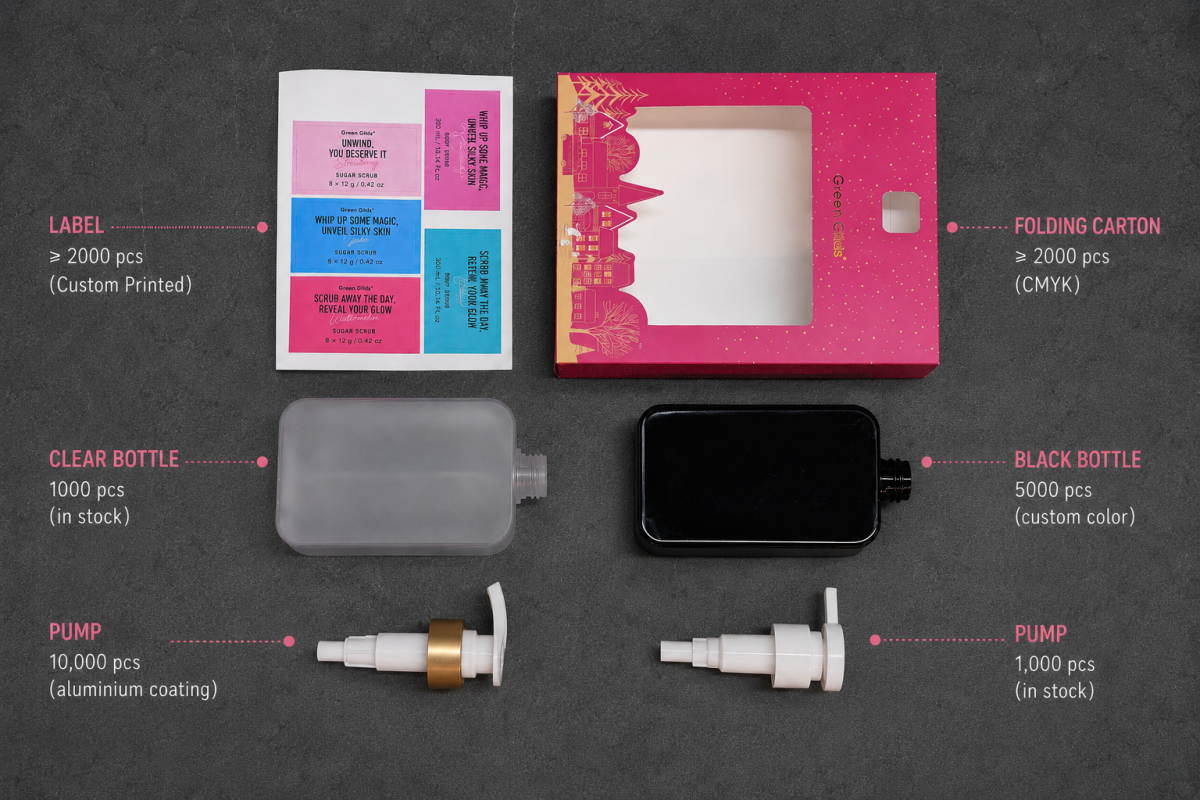
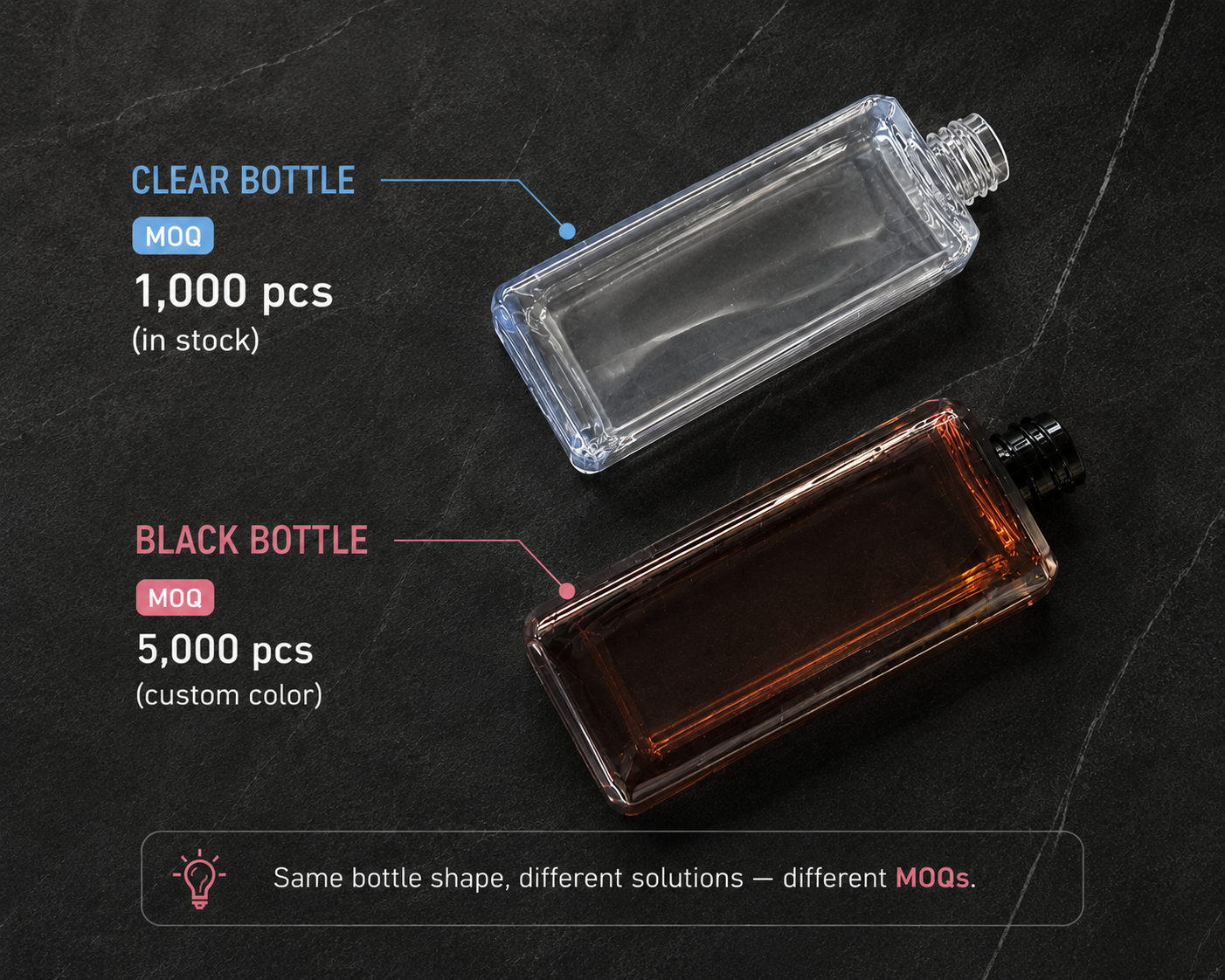
Take a standard clear PET bottle: available off-the-shelf from 1,000 pcs. The client says they'd like it in a specific Pantone colour instead. Now the supplier needs to compound the colour, set up the line, and run a full production batch — MOQ jumps to 5,000 pcs. Client says fine, keep the clear bottle, but print the logo on it. Bottle MOQ stays at 1,000. Printing MOQ is now 3,000.
One small visual decision. Completely different supply chain implications.
Why "Just a Few Less" Is Sometimes Genuinely Difficult
A supplier with a 5,000 pc packaging MOQ might agree to 3,000. Possible, usually at a higher unit cost.
But if the standard MOQ is 10,000 and you want 500, that's a different situation. A lot of the costs don't scale with quantity: the line still needs to be set up, the colour still needs to be matched, the tooling or plate still needs to be made, and there's always a run-in before production stabilises. Less volume doesn't mean proportionally less cost — it gets concentrated into fewer units, and the per-unit price stops making sense.
So when we decline a very low MOQ request, it's not usually because we don't want the business. It's that we've done the numbers and the price we'd have to charge wouldn't actually serve the client well.
Instead of Pushing the MOQ Down, Look at the Product
If a client tells us their first order caps out at 2,000 units, that's the brief. 2,000 is the constraint.
At that point, the more useful question isn't "can you lower the 5,000 MOQ?" — it's "what can we adjust in the product to work within 2,000?"
Custom colour bottle → is there a stock option that works? Direct print → how does a label look? Every SKU in its own box → can the carton structure be shared, with only the label changing? Five SKUs → can any packaging components be consolidated to pool quantities?
MOQ stops being a fixed wall when you approach it as a product design question. There are always trade-offs — if you need 500 pcs with a fully custom formula, custom bottle, custom Pantone, custom printing, and custom box at bulk pricing, that's a genuinely hard ask. But if you know which elements matter most to the brand, and which ones can be simpler for the first run, there's usually room to work with.
The Lowest MOQ Isn't Always the Right MOQ
I'm cautious about positioning "we can do 100 pcs" as a selling point.
Not because 100 units isn't possible — with off-the-shelf packaging, a label, and a pre-developed formula base, a lot of products can be done in very small quantities. The question is whether those 100 units share a supply chain with the product you'll eventually be selling at scale.
If the first run uses Packaging A, and by 5,000 units you realise Packaging A doesn't work commercially, and you switch to Packaging B — the bottle changes, the label needs resizing, the outer carton dimensions shift, compatibility and stability need reconfirming. As we outline in our guide to cosmetic testing before production, the choices you make in the first run have downstream implications that aren't always visible at the sampling stage.
For brands that are serious about taking a product to market, what's worth looking for isn't the lowest possible MOQ. It's the lowest commercially sensible MOQ — not "what's the minimum we can make," but "what's the minimum that actually makes sense to start from."
MOQ Reference by Category
MOQ varies too much to capture in a single number, but the table below gives a useful sense of the ranges across different components and processes.
| Component | Specification | MOQ |
|---|---|---|
| PACKAGING & COMPONENTS | ||
| PET Bottle | Standard (Clear) | 1,000 pcs |
| Custom Color | 5,000 pcs | |
| Direct Printing | 3,000 pcs | |
| PET Jar | Standard (Clear) | 1,000 pcs |
| Custom Color | 10,000 pcs | |
| Direct Printing | 3,000 pcs | |
| Glass Bottle & Jar | Standard (Clear) | 1,000 pcs |
| Custom Color | 1,000 pcs | |
| Decalcomania | 2,000 pcs | |
| UV Coating | 10,000 pcs | |
| Electroplated | 10,000 pcs | |
| PE Tube | Standard (Clear) | 1,000 pcs |
| Frosted | 5,000 pcs | |
| Custom Color | 10,000 pcs | |
| Direct Printing | 5,000 pcs | |
| Aluminum Plastic Tube | Silver (Standard) | 10,000 pcs |
| Direct Printing | 10,000 pcs | |
| Pump | Standard | 1,000 pcs |
| Custom Color | 5,000 pcs | |
| UV Coating | 10,000 pcs | |
| Aluminium Coating | 10,000 pcs | |
| Lid | Standard | 1,000 pcs |
| Electroplated | 3,000 pcs | |
| Custom Color | 10,000 pcs | |
| Direct Printing | 10,000 pcs | |
| Label | Digital Printing | ≥ 100 pcs |
| Custom Printing | ≥ 2,000 pcs | |
| Folding Carton | Digital Printing | ≥ 100 pcs |
| CMYK Printing | ≥ 2,000 pcs | |
| FORMULA & BULK | ||
| Cream / Lotion / Butter | Minimum batch | 200 kg |
| Gel / Wash / Scrub | Minimum batch | 30–150 kg |
| Soap — Melt & Pour | Minimum batch | 20 kg |
| Soap — Triple Milled | Minimum batch | 100 kg |
| Bath Bomb | Per formulation | 1,000 pcs |
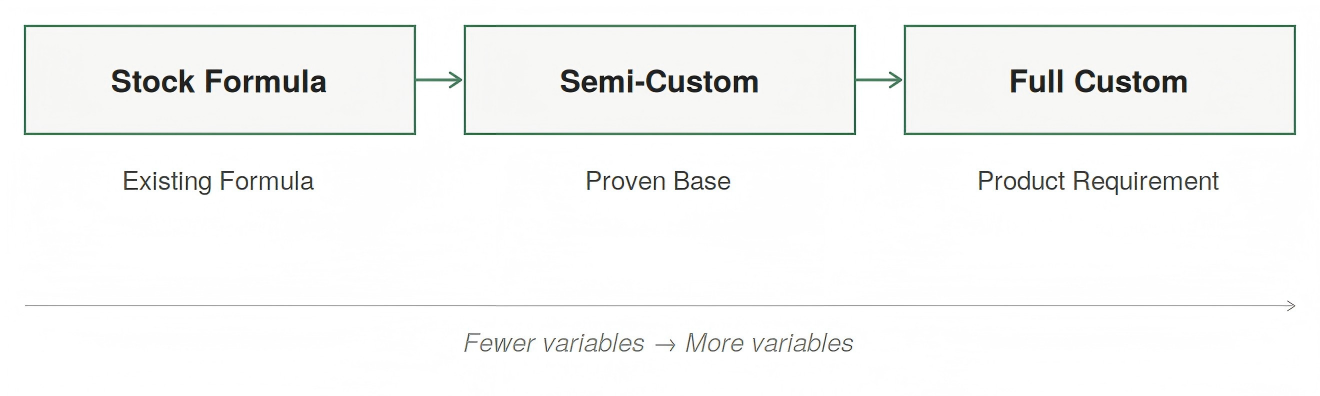
One pattern that tends to hold: stock items are flexible, custom items are not. The further you move toward customisation — in colour, material, process, or form — the higher the minimum quantity becomes.
So the next time an MOQ feels too high, my first question isn't "can we go lower?" It's: which component is actually setting that number? Once you find it, the conversation usually gets a lot more productive.
Working on your first product or scaling an existing line? Contact us or learn more about our product development approach.