


Malezia came to us with a clear brief and an unusually strict constraint: an effective 10% Azelaic Acid blemish-treatment product that also honored their core brand promise — a formula free of any ingredient known to feed Malassezia, the yeast implicated in fungal acne and seborrheic conditions. What followed was ten months of iterative formulation work — testing solubility approaches, sourcing a finer-grade active ingredient to eliminate grittiness, and fine-tuning pH to balance potency against irritation — before the formula and its packaging were both ready for production.
The client's Malassezia-safe guidelines ruled out fatty acids with 12–24 carbon chains, their esters and fatty alcohols, and nearly all oils, which eliminated most conventional emulsifiers and solubilizers before formulation even began.
Solving the chemistry before touching packaging. Azelaic acid's low water solubility usually gets handled with a solvent-heavy serum or a suspension stabilized by common thickeners — several of which sat on the client's prohibited list. We tested both directions in parallel: a solvent-based serum (using dipropylene glycol and polyols) and a suspension-cream route (built around a specialty suspending polymer), tracking cold-temperature stability at every step since several formulas separated below 0°C.
This kind of formula-system rebalancing — where changing one variable shifts several others at once — is exactly what we cover in A Cosmetic Formula Is a System.
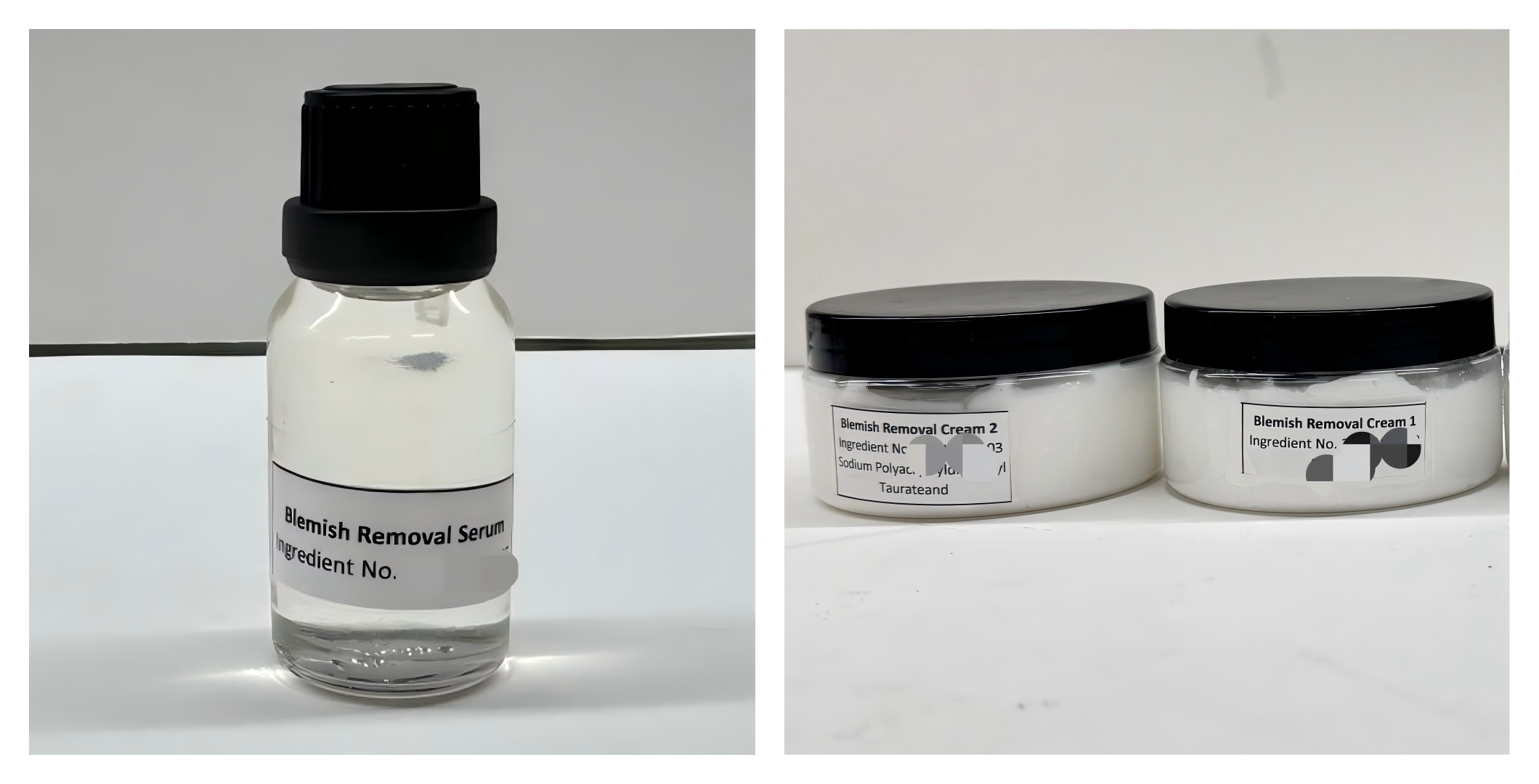
Sourcing a finer particle size to eliminate grittiness. Azelaic acid's crystalline structure is the direct cause of the gritty feel that plagues many suspension-based formulas — a common complaint the client had already run into with off-the-shelf alternatives. We worked through this by evaluating azelaic acid from different suppliers at different particle sizes: a coarser ~30-micron grade produced a noticeably gritty texture even at the same 10% concentration, while switching to a finer ~5-micron grade all but eliminated it. Getting to that finer grade meant sourcing from a different supplier and, where needed, grinding larger batches down further during processing.
Working within a narrower ingredient palette than usual. The client came with their own research on Malassezia-safe emulsifier chemistry, including published studies on which ingredient classes were implicated in yeast growth. We cross-referenced their list against our lab's working formulas and iterated on emulsifier selection accordingly — swapping out common polymer-emulsifier blends that didn't pass the client's Malassezia-safe screen for Sodium Polyacryloyldimethyl Taurate, and adjusting pH with a mild buffer to balance azelaic acid's efficacy against skin comfort.
Balancing pH between efficacy and irritation. Azelaic acid's active, un-ionized form is most abundant at low pH — roughly 92% at pH 3.5, dropping to about 26% by pH 5.0 — so pushing pH down maximizes potency. But lower pH also means more irritation potential on skin. We worked with the client to land on a pH around 4.0–4.5, a range that preserved a strong majority of the active form while keeping the formula comfortable to use daily.
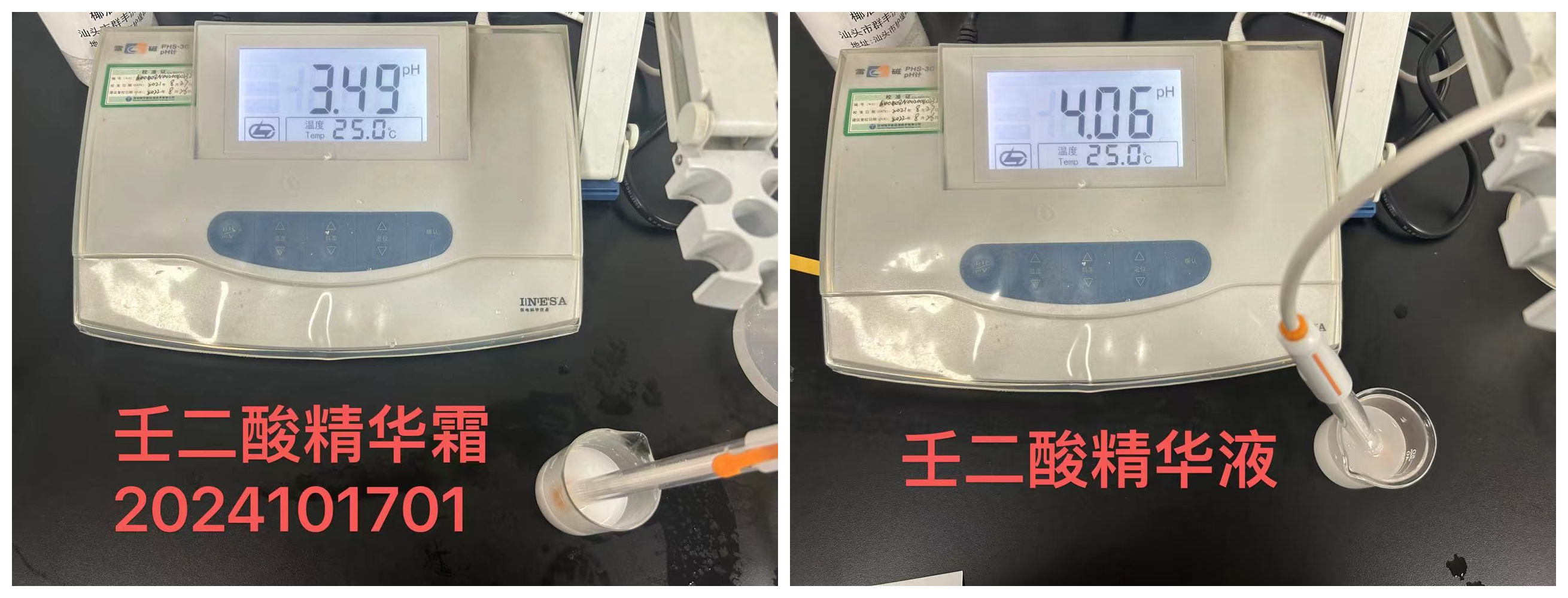
Adding an anti-inflammatory active to offset irritation. Even at a carefully chosen pH, 10% azelaic acid is a strong enough active to cause some skin irritation on its own. We built in Bisabolol at a supporting level specifically to counteract this — letting the formula keep its full-strength active concentration without compromising on comfort.
Refining texture through direct client testing rounds. Two full rounds of physical samples went back and forth for hands-on evaluation. The client's testing surfaced specific problems we wouldn't have caught in the lab alone: excessive pastiness and visible peeling in one cream version, oily residue and pilling when layered with the companion moisturizer in another. Each round of feedback drove a targeted adjustment — reducing a specific thickener to lower viscosity, for instance — until the client's team confirmed the formula was ready to launch: "We really like this formula and want to proceed with launching it."

Matching packaging color to an exact reference standard. Once the formula was locked, packaging took its own several rounds: matching an aluminum tube and paper box to a specific "blood red" shade the client referenced against external color tools, then reconciling matte vs. glossy finish preferences across both substrates. Each new sample round required physically comparing tube and box side by side, since screen color and printed color diverged more than expected.

Several factors made this project more complex than a typical formulation-to-packaging handoff:
A restrictive ingredient list narrowed the usual toolkit. Common solubilizers and emulsifiers for azelaic acid were off the table, requiring several rounds of alternative testing.
Cold-stability failures forced a formula pivot. An initial serum system that performed well at room temperature separated below 0°C, requiring a shift toward a suspension-cream approach.
Sourcing a finer-grade active meant switching suppliers. The particle size needed to avoid a gritty texture wasn't available from the client's existing ingredient supplier, requiring us to qualify and test a new, higher-cost source mid-project.
Color matching across two substrates took multiple rounds. Aluminum tube and paper box samples needed independent color correction before they matched each other and the client's reference.
Each of these was worked through collaboratively rather than resolved in a single pass — a pattern that shaped the pace of the whole project.
The final formula — 10% Azelaic Acid with 4% Niacinamide in a Malassezia-safe cream base — passed the client's in-house texture and application testing, stability and packaging-compatibility checks, microbiological testing, and USP 51 preservative efficacy testing, meeting all criteria for US market launch. Packaging landed on a matte blood-red aluminum tube with a black cap and a matching matte paper box. The client signed the sales confirmation, paid their deposit, and placed a first production order for 10,032 units of the Azelaic Acid Cream alongside 30,000 units of a companion Urea Moisturizer, with a 45–50 day production lead time.
The Azelaic Acid Cream is now available from Malezia.
See how we think about preservative system design more broadly in How We Think About Preservation: A Multi-Hurdle Approach.
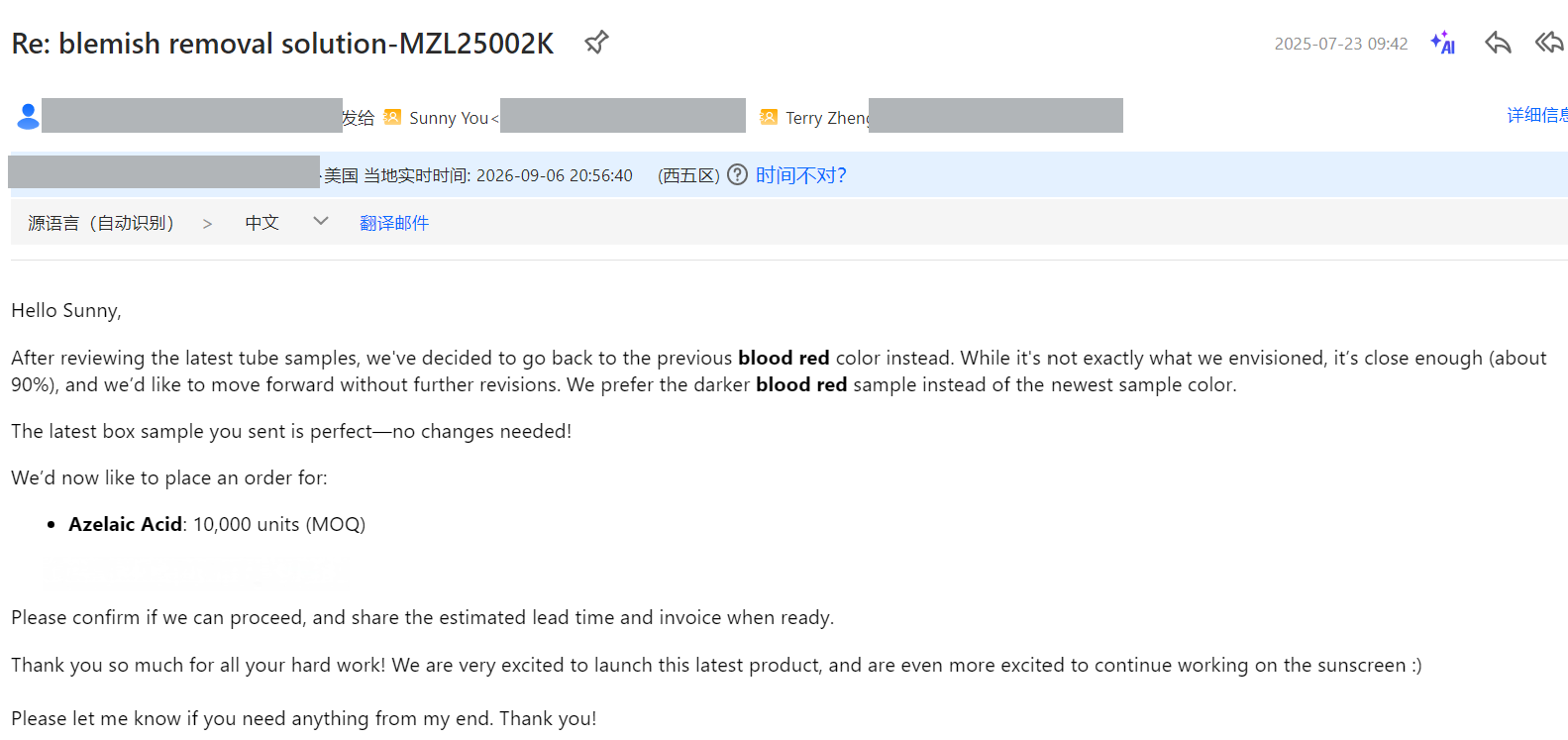

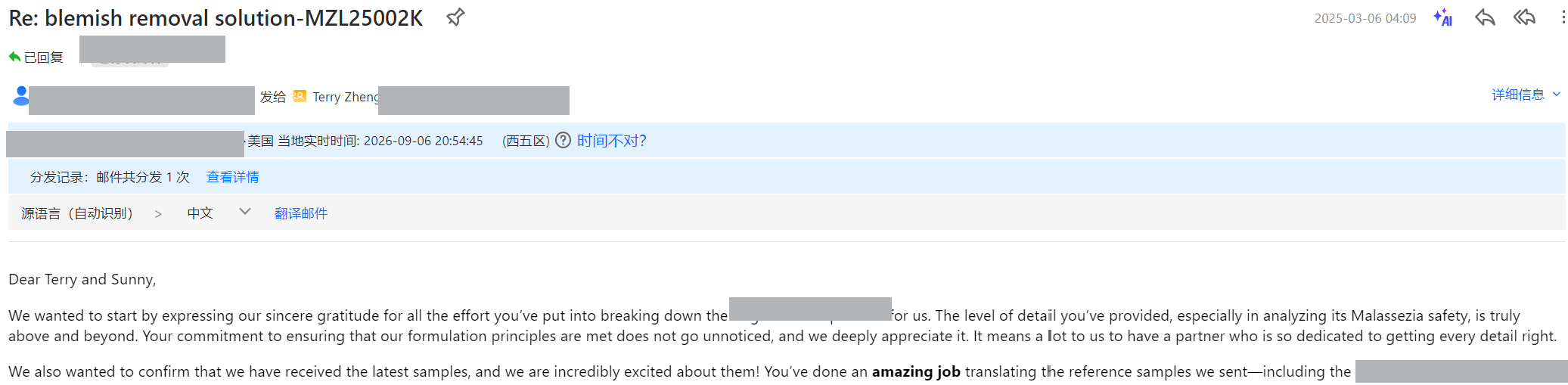
Client Feedback · March 2025
"It means a lot to us to have a partner who is so dedicated to getting every detail right."
— Malezia
Talk to our formulation team about your brief, timeline, and compliance requirements.
Talk to our team