

Over the past year, we've noticed a shift in how buyers approach formulation briefs. Ingredient exclusion lists that used to be the exception are now closer to the default, and increasingly, they arrive before we've even started formulating, not after a safety review flags a concern.
It's tempting to call this a regulatory trend. Part of it is. But a closer look at what's actually changing in the law, versus what buyers are asking for on top of it, tells a more accurate story.
What the regulation actually changed
Two updates are worth naming specifically, because they have real dates attached and genuinely affect anything currently in development.
Commission Regulation (EU) 2023/1545 expands the EU's declarable fragrance allergen list from 24 substances to roughly 82, updating Annex III of Regulation (EC) No 1223/2009. This is a disclosure requirement, not a ban, allergens must be individually listed on the label once they exceed set thresholds (0.001% in leave-on products, 0.01% in rinse-off). Products already on the market have until 31 July 2026 to comply or be withdrawn; new products entering the market after 31 July 2028 must comply from day one. For anything currently in formulation, these dates aren't abstract, they fall inside a typical development timeline.
Phenoxyethanol's regulatory story is worth untangling on its own, because the version that circulates in buyer briefs and the version actually in force rarely match. Under Regulation (EC) No 1223/2009, it remains permitted at up to 1.0%, with no EU-wide restriction tied to a child's age. The claim that it's "banned for children under three" traces back to a 2012 recommendation from France's ANSM, capping concentration at 0.4% and advising against use in nappy-area products for that age group, not an EU-wide rule. The SCCS revisited the question in 2016 and did not adopt the 0.4% cap, reaffirming 1.0% as safe. France introduced a narrower labelling requirement in 2019 restricting certain leave-on phenoxyethanol products from being marketed for the nappy area in children under three. That measure was referred to the Court of Justice of the EU, which found in September 2022 that a safeguard measure applied to an entire product category, rather than a specific identified product, exceeded what the cosmetics regulation's safeguard clause allows. Following that ruling, France's Conseil d'État annulled the underlying measure in December 2022. In practice, a national restriction with no continuing legal force is still shaping what some buyers ask for today.
Both of these are real, dated, and verifiable. That distinction matters, because what happens next in the market goes well beyond what either of them requires.
What buyers are asking for, ahead of the law
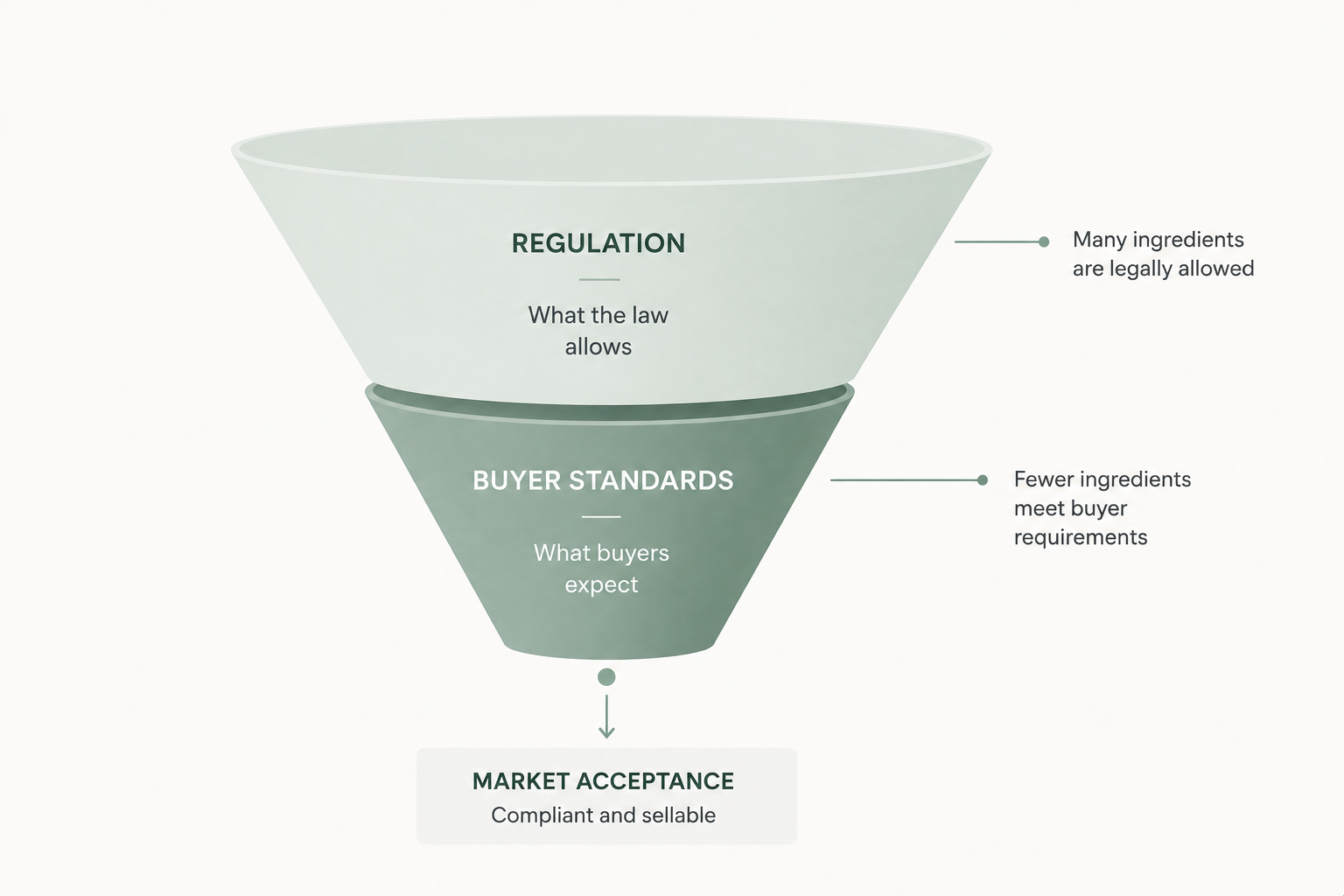
In practice, we're seeing buyer standards move faster and further than the regulation itself.
Phenoxyethanol is the clearest example. It remains permitted at up to 1.0% under EU law, with no blanket restriction for general use, and by this point, it's arguably the last mainstream preservative still standing. MIT was banned outright from leave-on products back in 2017 and squeezed to near-uselessness in rinse-off. Most parabens follow a similar script: only five long-chain variants were ever actually banned in the EU (back in 2014), but paraben-free became a market requirement long before it was a legal one, and the shorter-chain parabens that remain fully legal today get avoided anyway. If phenoxyethanol goes the same way, we're genuinely running out of preservatives that are both effective and not currently on someone's blacklist, at which point the product isn't clean, it's just undefended.
But a growing share of the buyers we work with exclude phenoxyethanol outright at the brief stage, regardless of intended concentration, sometimes citing the very restriction described above, years after it stopped having any legal force. The question they're asking isn't is this compliant, it's will this get flagged on a retailer's restricted list.
Children's products show the same pattern. EU regulation requires certain allergens to be disclosed above a threshold, and it prohibits specific azo dyes that release aromatic amines, it does not require zero allergens or a blanket exclusion of azo-derived colorants as a category. Increasingly, though, buyers are asking for exactly that: formulations with no declarable allergens at all, and colorant systems that are non-azo by category rather than by individual risk assessment. These are buyer-set standards, not legal minimums.
PEG follows a looser version of the same pattern. There's no EU-level ban on PEG compounds in cosmetics. The pushback we see is less about a specific legal restriction and more about a broader association, some of it tied to historical concerns over 1,4-dioxane as a processing byproduct, that has generalized into a category-wide preference against PEGs, independent of whether a given ingredient or supplier has addressed that concern.
| Criteria | Phenoxyethanol | Azo colorants | PEG |
|---|---|---|---|
|
Regulatory status What the law says |
Generally allowed Permitted in most major markets within concentration limits. | Allowed with restrictions Certain azo colorants are restricted or require labeling in some regions. | Generally allowed Widely permitted and commonly used across major markets. |
|
Market status What buyers are asking |
Increasing scrutiny Many buyers prefer phenoxyethanol-free or “clean” alternatives. | Growing avoidance “Azo-free” is a strong buyer preference, especially in EU and natural-focused brands. | Buyer-dependent Accepted by many, but some brands prefer PEG-free positioning. |
| The gap |
Compliant with regulations does not always mean acceptable in the market. Buyer standards often go beyond the law. |
||
None of this means buyer standards are unreasonable. Retailers and brands are managing their own risk, often shaped by markets, certifications, or consumer segments that sit outside what regulation requires. But it does mean compliant and sellable are no longer the same question, and treating them as interchangeable is where development timelines usually run into trouble.
Where consumer expectations fit in
This buyer-side caution doesn't exist in isolation. A 2024 NSF survey found that 65% of consumers said they actively look for transparent ingredient lists, and a majority said they prioritize recognizable, clean ingredients when choosing skincare. Buyer exclusion lists are, in part, a response to that expectation, a way of pre-filtering formulations before they ever reach a consumer who might read the label closely.
Where this leaves formulation
None of this means every formula should be stripped down for the sake of it, some problems genuinely need more than a handful of ingredients to solve properly. But the question we actually get asked has changed. It's not can we make this compliant anymore. It's can we still make this work, perform, stay stable, hold its cost, once we've taken away half the toolkit a buyer's list already ruled out.
That's not a paperwork problem. It's the part where a formulator earns their keep, not just fills in a checklist.