

An inquiry usually means an opportunity. In practice, the gap between how many inquiries we receive and how many turn into real development projects is wide.
Price isn't the main reason. Neither is MOQ, or how good the sales team is.
The more basic problem: an inquiry on a B2B platform doesn't always come from a B2B buyer.
Between 3 June and 28 September 2026, we went through all 652 inquiries Enrich received on Alibaba.com. They came from 116 countries and covered 53 product categories, mostly bath and personal care. I wanted to answer two questions. What were these buyers actually trying to do? And how big is the gap between interest in a product and a real OEM/ODM project?
These numbers reflect our business only. They don't speak for other suppliers on Alibaba.com, or for the personal care industry as a whole.
How Many of 652 Inquiries Became Projects?
| Stage | Inquiries | Share |
|---|---|---|
| Initial reply, declined, or closed | 548 | 84.0% |
| Project discussion or quotation | 91 | 14.0% |
| Sampling or ordering | 13 | 2.0% |
| Total | 652 | 100% |
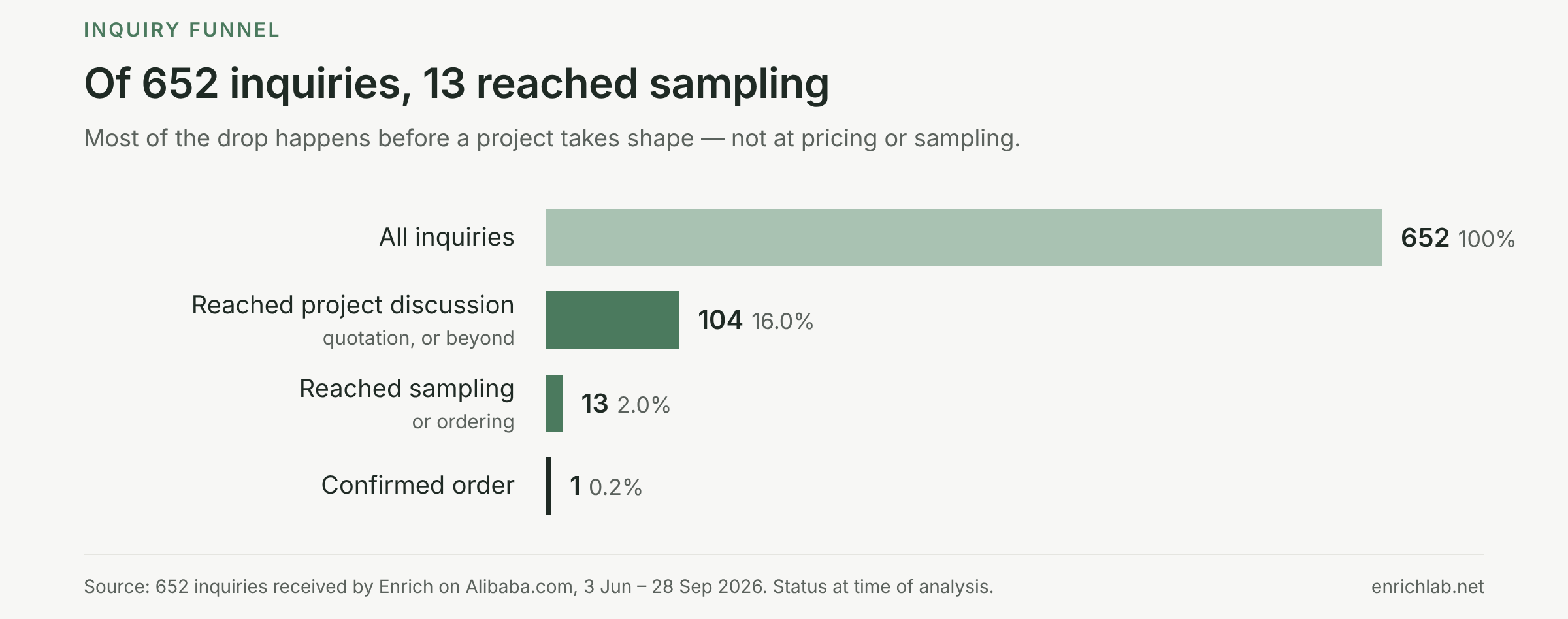
Of the 13 that reached sampling or ordering, 12 are in sampling. One has become a confirmed order.
This is a snapshot, not a lifecycle conversion rate. Some projects still in discussion or sampling will move further.
But one thing is clear. Most of the loss happens before a project takes shape. Not at the price negotiation. Not at sampling.
Every inquiry in our tracking carries a status tag, and 604 carry one of the tags below. For tracking convenience, some inquiries still in active follow-up are filed under these tags too — so read them as where conversations stand, not as final verdicts.
404 — the buyer never read our reply, or read it and went quiet (62.0%)
88 — the quantity didn't fit the production model
70 — not a target customer for us
35 — an issue with the product request itself
7 — blocked on price

That's not what most people expect. Price is usually seen as the main obstacle to closing a deal. In this data, most inquiries never got as far as talking price.
So before working on how to win more quotes, it's worth asking a simpler question: who is actually sending these inquiries?
Traffic on a B2B Platform Isn't Always B2B
Alibaba.com is a B2B sourcing platform. That doesn't mean everyone on it is sourcing. In our inquiries, the same four types of buyer show up again and again.
Individual consumers. They want a few units for themselves. They found the product through search or a recommendation, and don't realise they're talking to an OEM manufacturer.
Small retailers and wholesalers. They do run a business, but they want small quantities of stock, sometimes dropshipping. That's distribution, not OEM.
Early-stage brand founders. They have a product idea. Budget, quantity, packaging and launch plan are all still open.
Brands and buyers with a defined project. They know the product, the target market and the purchasing plan. They're looking for the right manufacturer.
All four can land on the same product page and send almost the same message:
“Can I have your catalog?”
“What is your best price?”
“How much is shipping?”
“Can I add my logo?”
None of these are bad questions. They just don't show that someone is ready to start an OEM project.
Interest in a product, intent to buy commercially, and the need for an OEM project are three different things. Wanting to buy is only step one. Whether the quantity, customisation and production model fit is what decides whether there's a real opportunity.
Why Suppliers Can't Fix This at the Source
Platforms bring visitors in through on-site search, recommendations, ads, RFQs and external search. Wide reach means more opportunities. It also means people with very different goals arrive at the same time.
A supplier can improve how products are presented. A supplier can't control who sees them, or who sends an inquiry.
Take a well-packaged body care product. A consumer wants one or two. A small retailer wants a few dozen in stock. A brand wants several thousand custom units, with its own formula, packaging and design. Same product. Three different business models.
Clear MOQs, a clear OEM/ODM scope and accurate product descriptions reduce the confusion. They don't remove it. That's why platform metrics and what a manufacturer actually cares about don't always line up.
| Common platform metric | What an OEM manufacturer actually needs to know |
|---|---|
| How many impressions a product gets | Whether it reached the right buyers |
| How many clicks a product gets | Whether the visitor needs OEM/ODM services |
| How many inquiries come in | How many become defined projects |
| Inquiry response rate | Whether the conversation moves the project forward |
| Whether store traffic is growing | Whether it produces opportunities we can act on |
This isn't specific to one platform. Any platform that serves broad product interest and many kinds of buyer will run into the same mismatch.
Which Inquiries Actually Become Projects?
If you can't control where the traffic comes from, can the inquiry itself tell you anything about intent?
We sorted all 652 inquiries into five groups based on the first message, then tracked each group's progression rate: the share that moved into project discussion, quotation, sampling or ordering.
| First inquiry type | Inquiries | Progression rate |
|---|---|---|
| Only a link, or general interest | 226 | 3.1% |
| A single question on product, price or shipping | 157 | 8.9% |
| A concrete next step: quantity, samples or customisation | 126 | 24.6% |
| Several clear purchasing conditions at once | 123 | 40.7% |
| Too little content, or other special cases | 20 | 10.0% |
| All inquiries | 652 | 16.0% |
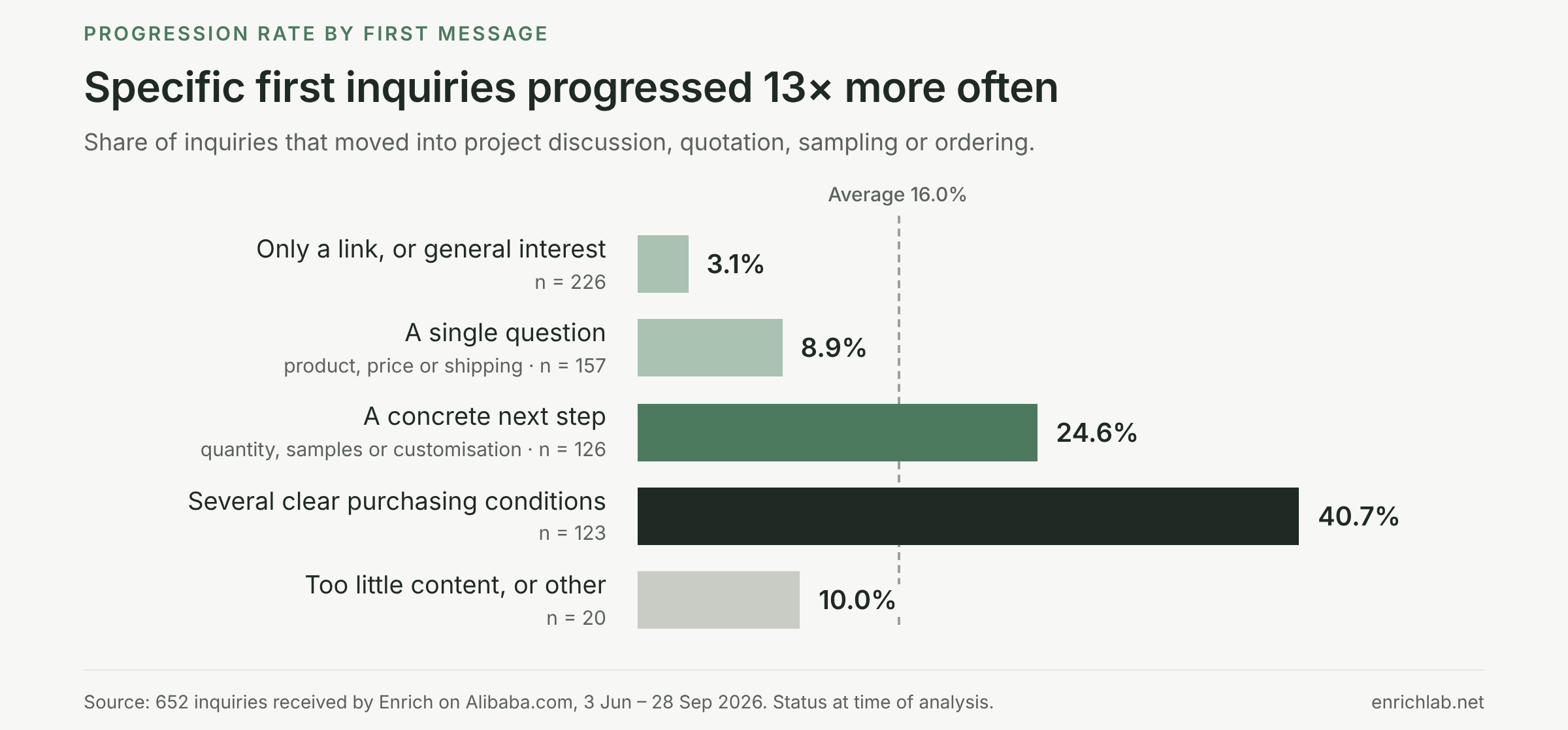
The gap is hard to miss. Of the 226 inquiries that sent only a link or a general expression of interest, 3.1% progressed. Of the 123 that laid out several purchasing conditions up front, 40.7% did. More than 13 times higher.
Those conditions include product specs, expected quantity, packaging, customisation, target market, sample plans and launch timing. Their value isn't that they make an inquiry look professional. It's that they show the buyer has started thinking about execution.
One caveat. Platforms now offer suggested questions, structured forms and AI-assisted writing, so first messages are getting longer and more complete. An inquiry with a dozen technical questions isn't necessarily worth more than a one-liner like “Can you manufacture this formula?”
What matters isn't how detailed the first message is. It's whether the buyer can confirm real conditions as the conversation goes on. That's why we judge an inquiry by how the conversation develops, not by the first message alone.
Exposure Isn't Demand
Inquiry volume doesn't tell you much about market demand either.
Gift sets and kits brought in 171 of our 652 inquiries, more than any other category. But we also list a lot of gift set products on Alibaba.com. Listing count, exposure and traffic allocation all shape how many inquiries come in. Read volume as demand and you'll reach the wrong conclusion.
The more useful number is what happened next. Of those 171 gift set inquiries, 9 progressed. That's 5.3% — about a third of the 16.0% average.
Gift sets are attractive products. The mix of items, the packaging, the gifting angle — they pull interest easily. But that interest didn't turn into OEM demand at the same scale. Some buyers wanted small quantities of stock. And a genuinely custom gift set involves several products, packaging materials and assembly, which only makes commercial sense above a certain volume.
That doesn't mean gift sets lack a market. It means that among the buyers we reached, few were ready for an OEM project.
Whether a product is a real opportunity depends on more than how many people are interested. It depends on whether that demand fits your development capability, production scale and business model. Exposure gets you seen. It doesn't prove demand.
For Brands: What a First Inquiry Should Include
If you're looking for an OEM/ODM manufacturer, the data above applies to you directly. The inquiries with the highest progression rate usually made these points clear from the start.
What the product is. Category, size, texture or functional direction. A reference product helps.
How many. Expected first-order quantity, and whether repeat orders are planned.
Packaging. Whether you already have packaging, or need it developed too. Any material requirements.
How much customisation. A new label, an adjusted existing formula, or a full new development.
Where it will be sold. The target market decides the regulatory requirements and the testing you'll need.
Timing. When you'd like samples, and when you plan to launch.
Budget. A target retail price or unit price range, even a rough one.
You don't need every answer settled. “Not sure yet” is useful too — it tells the manufacturer where to start. What actually slows a project down is “send me your best price” followed by silence.
If quantity is your main concern, start with our article on where MOQ actually comes from.
Traffic Creates Contact, Not Demand
Among these 652 inquiries, some people were just curious. Some wanted a small amount of stock. Some were exploring whether to build a brand. And some already had a clear development plan and were looking for a manufacturer to carry it out.
All of that is real demand. It just doesn't fit one supply model. So inquiry volume isn't a fair measure of a product's potential, and not every inquiry that stalls is a sales failure.
Traffic creates contact. It doesn't create demand.
What we want to build isn't a single transaction. It's a partnership that runs from product concept, through formulation, to actual production.
About the data: This article is based on 652 inquiries Enrich Enterprises received on Alibaba.com between 3 June and 28 September 2026. Project status reflects the point of analysis, and some projects are still in progress. The analysis reflects our own business experience and should not be read as representing Alibaba.com overall or the personal care industry.
Have a project with a clear brief, or still working one out? Contact us or see how we work.