
Brands preparing to sell cosmetics in the EU often use "CPNP," "PIF," and "CPSR" as if they mean the same thing. They don't.
The CPSR is the safety report. It forms part of the PIF, which is the broader product documentation file. CPNP is different — it is the EU's electronic notification system used before a cosmetic product is placed on the market.
The confusion usually becomes a practical problem during product development: what information is actually required, who prepares it, and who is responsible for making sure it is complete?
In an OEM or CDMO project, the answer is rarely one party. Formula and manufacturing data may come from the manufacturer, ingredient documentation from suppliers, safety conclusions from a qualified safety assessor, and product or claim information from the brand.
This article explains how CPNP, PIF and CPSR fit together, what information is commonly needed, and who normally provides it.
1. CPNP, PIF and CPSR — How They Fit Together
CPSR — Cosmetic Product Safety Report
Before a cosmetic product is placed on the EU market, the Responsible Person must ensure that the product has undergone a safety assessment and that a Cosmetic Product Safety Report (CPSR) has been prepared, as required under Regulation (EC) No 1223/2009.
The CPSR consists of:
- Part A — Cosmetic Product Safety Information
- Part B — Cosmetic Product Safety Assessment
Part A gathers the information needed to evaluate the product's safety. Part B contains the safety assessor's assessment, conclusion and reasoning.
PIF — Product Information File
The Product Information File is the broader product file maintained by the Responsible Person.
The CPSR forms part of the PIF, but the PIF also contains other information such as the product description, manufacturing method and GMP compliance, claim substantiation where applicable, and relevant information on animal testing.
The PIF must be kept for 10 years after the last batch of the product has been placed on the market and must be readily accessible to the relevant competent authority.
CPNP — Cosmetic Products Notification Portal
CPNP is different.
It is the EU's electronic notification system for cosmetic products. Before placing a cosmetic product on the EU market, the Responsible Person submits the information required under Article 13 through the CPNP.
In short:
- CPSR → forms part of the PIF
- PIF → product documentation maintained by the Responsible Person
- CPNP → separate pre-market notification
They work together, but CPNP does not contain the PIF.
2. CPSR Part A — Documents Commonly Collected for the Safety Assessment
Part A of the CPSR gathers the information needed for the safety assessment.
Annex I of Regulation (EC) No 1223/2009 defines the information that the CPSR must address. In practice, preparing that information requires supporting data and documents from manufacturers, raw material suppliers, fragrance suppliers and testing laboratories.
The exact document package varies depending on the formula and product type.
Core Product and Ingredient Documentation
| Item | Typical Source |
|---|---|
| Finished product INCI / quantitative formula | Manufacturer |
| Raw material SDS | Raw material supplier |
| Raw material specification / technical data | Raw material supplier |
| Raw material CoA | Raw material supplier / manufacturer |
| Fragrance IFRA certificate | Fragrance supplier |
| Fragrance SDS | Fragrance supplier |
| Fragrance allergen declaration | Fragrance supplier |
| Microbiological data / testing | Manufacturer / testing laboratory |
Additional Supporting Documents
| Item | Typical Source |
|---|---|
| Finished product specification / CoA | Manufacturer |
| Finished product SDS, where applicable or requested | Manufacturer |
| Stability data | Manufacturer / testing laboratory |
| Packaging compatibility data | Manufacturer / packaging supplier |
| Preservative efficacy / challenge test, where relevant | Manufacturer / testing laboratory |
| Fragrance composition information required for assessment | Fragrance supplier |
| Additional analytical testing, where justified | Manufacturer / testing laboratory |
These documents should not be interpreted as a fixed regulatory checklist where every document is mandatory for every cosmetic product.
The purpose is to provide the safety assessor with sufficient, relevant and reliable information to complete the assessment required by Annex I.
The regulation defines the safety information that must be assessed; the supporting documents used to establish that information can vary from product to product.
3. CPSR Part B — Who Writes the Safety Assessment?
Part B is different from Part A.
Rather than simply collecting supporting data, this is where a qualified safety assessor evaluates the information gathered in Part A and determines whether the cosmetic product is safe for its intended use.
Part B includes:
- Assessment conclusion
- Labelled warnings and instructions of use
- Scientific reasoning
- Safety assessor's credentials and final approval
The cosmetic product safety assessment must be carried out by a person with the qualifications required under Regulation (EC) No 1223/2009.
In an OEM/CDMO project, the manufacturer may help coordinate the assessment with a qualified third-party safety assessor. Alternatively, the brand or Responsible Person may appoint its own assessor.
Either approach can work. What matters is that the assessor is appropriately qualified and has access to the information necessary to perform the assessment.
4. What Else Does the PIF Contain?
The CPSR is an important part of the PIF, but it is not the entire PIF.
Under Article 11 of Regulation (EC) No 1223/2009, the PIF also covers:
- A description of the cosmetic product
- The method of manufacturing and a statement of compliance with Good Manufacturing Practice
- Proof of the effect claimed for the cosmetic product, where justified by the nature of the effect or product
- Data on any animal testing performed
This is why a PIF is broader than a safety file — it also has to reflect the product's real manufacturing process, its claims, and its testing history.
5. Who Is Responsible for What?
In a typical OEM/CDMO relationship, responsibilities usually split along these lines:
- Manufacturer — formula, manufacturing method, GMP compliance, product specification, stability, and coordinating with suppliers for raw material documentation.
- Raw material and fragrance suppliers — SDS, technical data, CoA, IFRA certificates, allergen declarations.
- Safety assessor — CPSR Part B, the actual safety conclusion.
- Brand / Responsible Person — product claims, packaging artwork, market-specific labelling requirements, and CPNP submission.
No single party holds the entire compliance package. The manufacturer's role is to make sure its own documentation, and the documentation it can obtain from its supply chain, is complete and accurate — but the safety conclusion and the final regulatory submission sit with the Responsible Person and the assessor they engage.
6. A Practical Sequence
Cosmetic compliance in the EU works best when documentation responsibilities are identified early, not assembled retroactively once a product is already finished.
A typical project runs into trouble when documentation gets treated as a final step rather than a parallel track. If a formula changes late in development, every downstream document — the CPSR, the PIF, sometimes the CPNP notification itself — may need to be revisited. This is why we build documentation checkpoints into a project as early as the formula stabilizes, rather than after packaging and artwork are locked.
The Responsible Person retains ultimate legal accountability, but a well-organized supply chain — with the manufacturer proactively supplying complete, accurate documentation — is what actually makes a smooth CPNP submission possible.
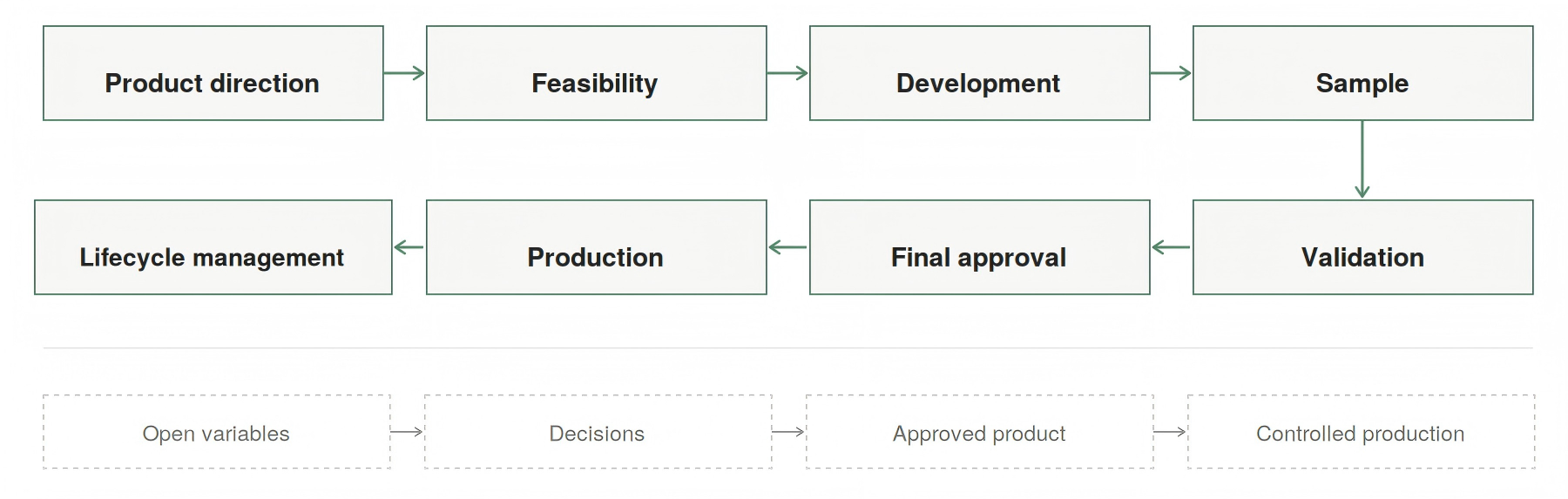
Formula development → supporting data collection → safety assessment → PIF completion → CPNP notification → EU market placement
The process becomes much easier when documentation is treated as part of product development rather than something added at the end.
Regulatory requirements vary depending on the product, formulation, claims and circumstances. This article provides a practical overview and does not replace product-specific assessment by a qualified safety or regulatory professional.
Want a clearer picture of how this fits into your project? See how we handle compliance, or reach out to talk through your target market.