

On OEM/ODM projects, clients often ask a very direct question:
"Do you know this product? Can you make it exactly to my formula?"
That's not actually a stock-versus-custom, pick-one question.
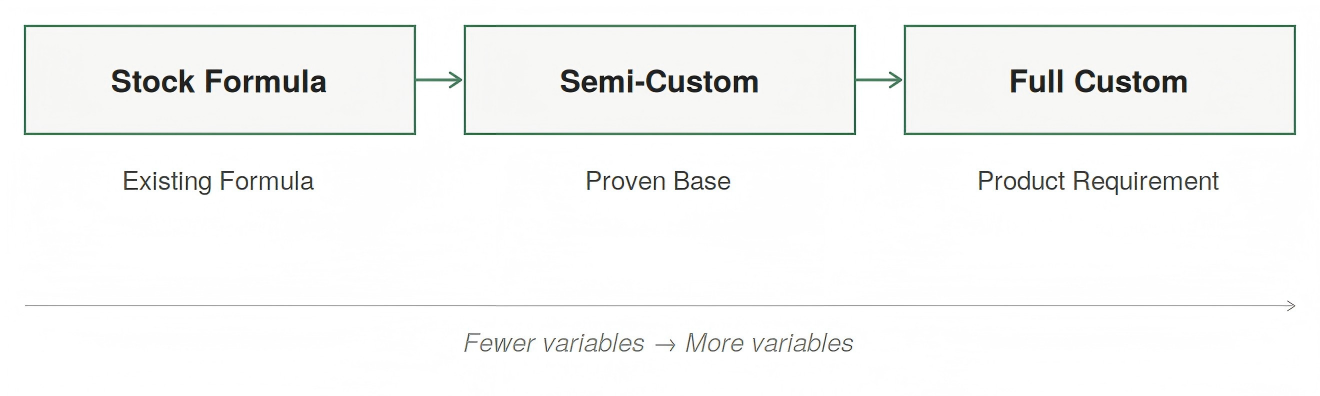
Most projects sit somewhere on a continuum:
Stock Formula → Semi-Custom → Full Custom
The real difference between them isn't product quality, and it isn't documentation standard. It's where formula development actually starts, and how many variables need to change from there.
1. Stock Formula: Start From a Proven Formula
Stock Formula means an existing formula that's already fully developed and has a mature production base behind it.
"Stock" here doesn't mean filled, ready-to-ship inventory sitting in a warehouse. For an OEM project, it's closer to: the client starts the project from a formula that's already been validated.
Take an existing body wash formula, for example — its surfactant system, thickening system, preservative system, and basic skin feel are all already set. The client might only need to adjust the fragrance, the color, the packaging, the product name and positioning, or a small number of non-core ingredients.
The biggest advantage here isn't just lower development cost. It's that fewer variables need to be re-solved.
If a brand is testing a new category, or just wants to get a product to market faster, Stock Formula is often a genuinely practical place to start.
Worth being clear about: Stock Formula isn't the same as white-label, off-the-shelf product. The product still goes through a normal OEM production process built around the client's brand, packaging, and market requirements.
2. Semi-Custom: Start From a Proven System, Then Adjust
Semi-Custom is one of the most common approaches on OEM/ODM projects.
It's usually not building a whole new formula from scratch — it's starting from a proven formula system and adjusting it to the project's requirements.
Say a client likes how an existing body wash performs overall, but wants to add niacinamide, adjust the viscosity, change the foam, switch the fragrance, go from clear to pearlescent, drop an ingredient they don't want, or adjust certain raw materials for a target market.
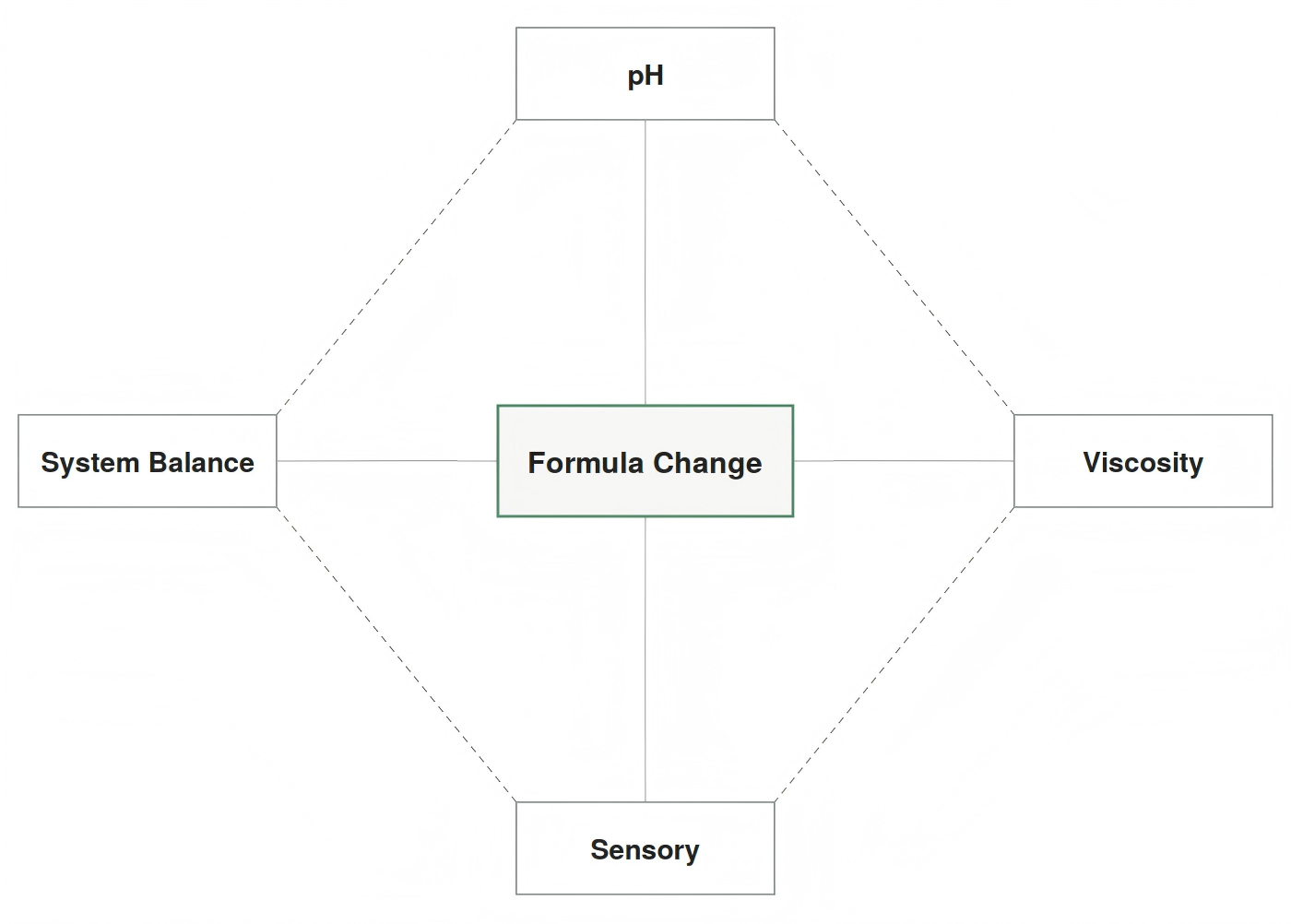
Projects like this can look like "just changing a few ingredients." In practice, a formula is a complete system (we go into this properly in A Cosmetic Formula Is a System). Adding one active, for instance, can shift pH, viscosity, skin feel, and the balance of the whole system at once.
So Semi-Custom isn't just bolting a selling-point ingredient onto an existing formula. It's rebalancing whatever needs to change while keeping as much of the proven system intact as possible.
For brands that already have a clear product direction but don't need to rebuild the whole system, this is usually the more sensible choice.
3. Full Custom: Start From the Product Requirements
Full Custom starts from a different place entirely.
Here, R&D doesn't hand the client an existing formula to react to. It starts by answering one question: what does this product actually need to do?
A client might specify a named active and its exact level, a particular texture or skin feel, specific foam performance, ingredients that have to be excluded, a defined ingredient philosophy, a clear benchmark, a target claim, or specific packaging compatibility requirements.
From there, R&D decides on the surfactant system, the emulsification system, the rheology system, the preservative system, and the active combination — built around those conditions.
So Full Custom doesn't necessarily mean everything starts from zero. It means the development logic starts from the product's requirements, not from an existing formula.
A Real Example: A Custom Sunscreen Project
Sunscreen is a fairly typical Full Custom project.
A client rarely just says "we want a sunscreen." They usually specify SPF, skin feel, color, ingredient restrictions, packaging format, sometimes even the use case, all at once — for example, a target SPF, a bit of tint, no visible white cast, a specific skin feel, restricted oils or ingredients, and a defined packaging format.
It's genuinely hard to start from an existing base formula and make a few small adjustments here. The whole formula structure has to be built and balanced around these requirements from the ground up.
See how this actually played out: From Ingredient Audit to SPF 42.
4. The Core Difference Between the Three
The one thing worth remembering here: customization is not a quality tier. Stock Formula doesn't make a product more basic, and Full Custom doesn't automatically make it better. They're just different development paths.
5. How to Tell Where Your Project Should Start
If you're not sure whether you need Stock, Semi-Custom, or Full Custom, a few practical questions usually settle it.
1. Do you already have a clear benchmark?
If the brief is just "we want to make a body wash," there's usually no need to start with Full Custom.
But if it's "we want the foam, skin feel, and viscosity close to this benchmark, but these specific ingredients need to go," the development depth changes completely.
2. If an existing formula's overall performance already works, would you use it as-is?
If yes, Stock Formula is often already enough.
If the overall performance is acceptable but you still want to change the fragrance, color, an active, or a few ingredients, that's usually closer to Semi-Custom.
3. Is there anything that absolutely has to be added or removed?
For example: a specific active that must be included, an active that must hit a certain level, a class of preservative that can't be used, oils that can't be used, or a specific ingredient philosophy that has to be followed.
The more restrictions there are, the less room there is to just use an existing proven formula — and the project drifts from Semi-Custom toward Full Custom.
4. Is texture and skin feel actually core to the product?
"A moisturizing body lotion" and "fast-absorbing, non-tacky, silicone-free, but still rich enough for dry skin" are both body lotions on paper. The development requirements behind them are not remotely the same.
If texture, skin feel, or the use experience itself is the product's core selling point, that usually calls for deeper formula development.
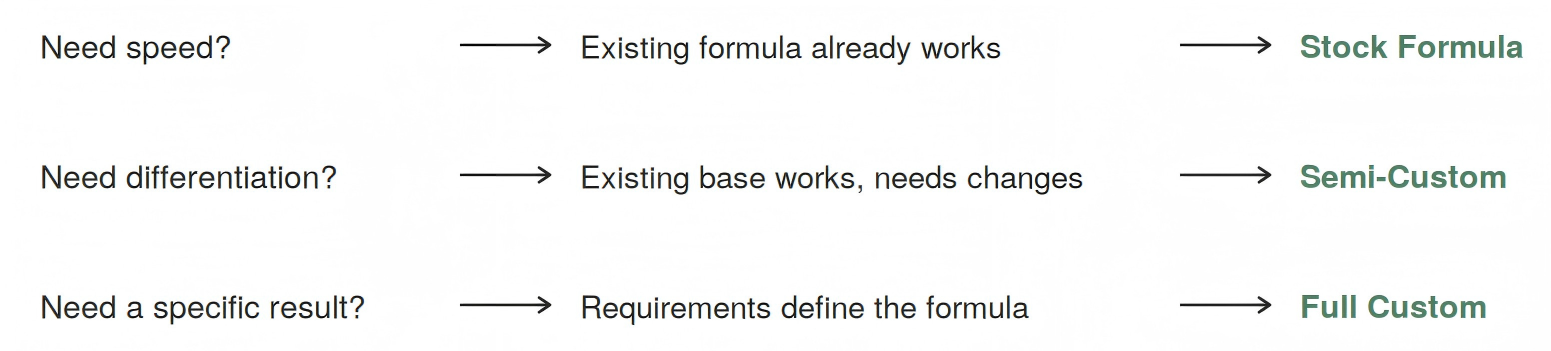
5. What actually matters most on this project?
If it's getting to market faster, Stock Formula is usually the better place to start.
If it's building brand differentiation on a proven base, Semi-Custom usually fits better.
If it's hitting one specific, non-negotiable technical result, the project is usually closer to Full Custom.
Closing Thought
Stock Formula, Semi-Custom, and Full Custom aren't three quality tiers. They're three different starting points for formula development.
Stock Formula starts from an existing formula. Semi-Custom starts from an existing system. Full Custom starts from the product's requirements.
The real question for a brand was never "should we do Full Custom." It's: how much actually needs to be redefined for this project?
Once that's clear, the development path usually is too.
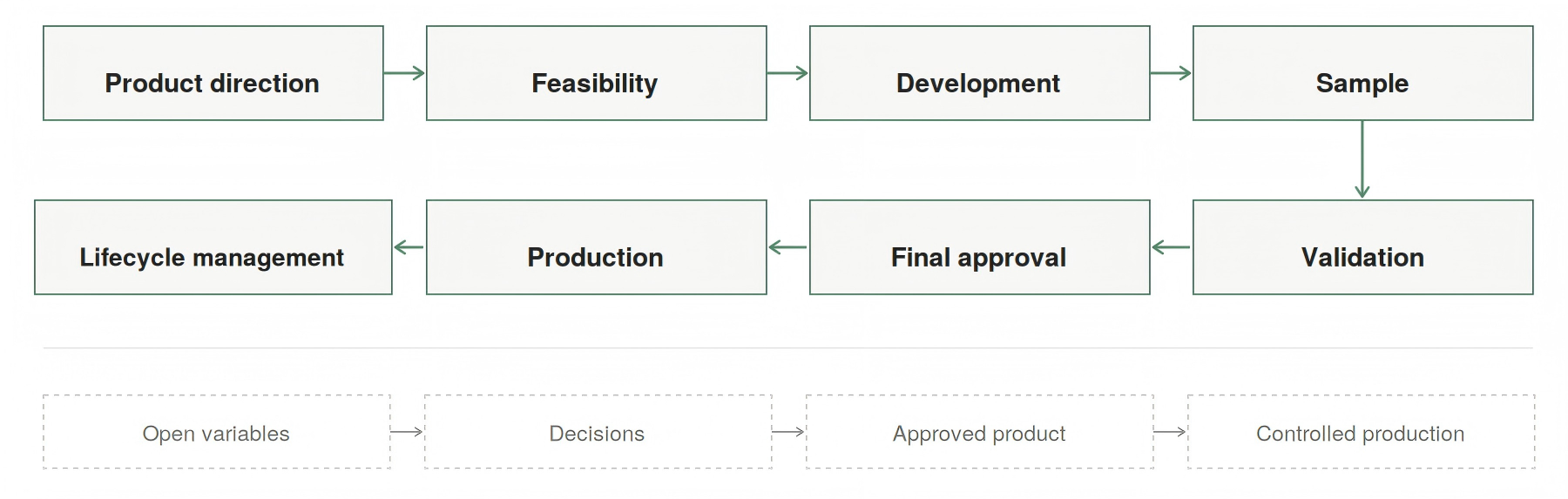
This decision is also the first stop in a longer chain — see how it fits into the rest of an OEM project in Cosmetic OEM Process: How a Product Gets Decided, One Step at a Time, or get in touch to talk through your own product.
.jpeg)
