

On paper, an OEM project looks simple:
Need → Development → Sampling → Confirmation → Production → Shipping
In practice, it's rarely this clean.
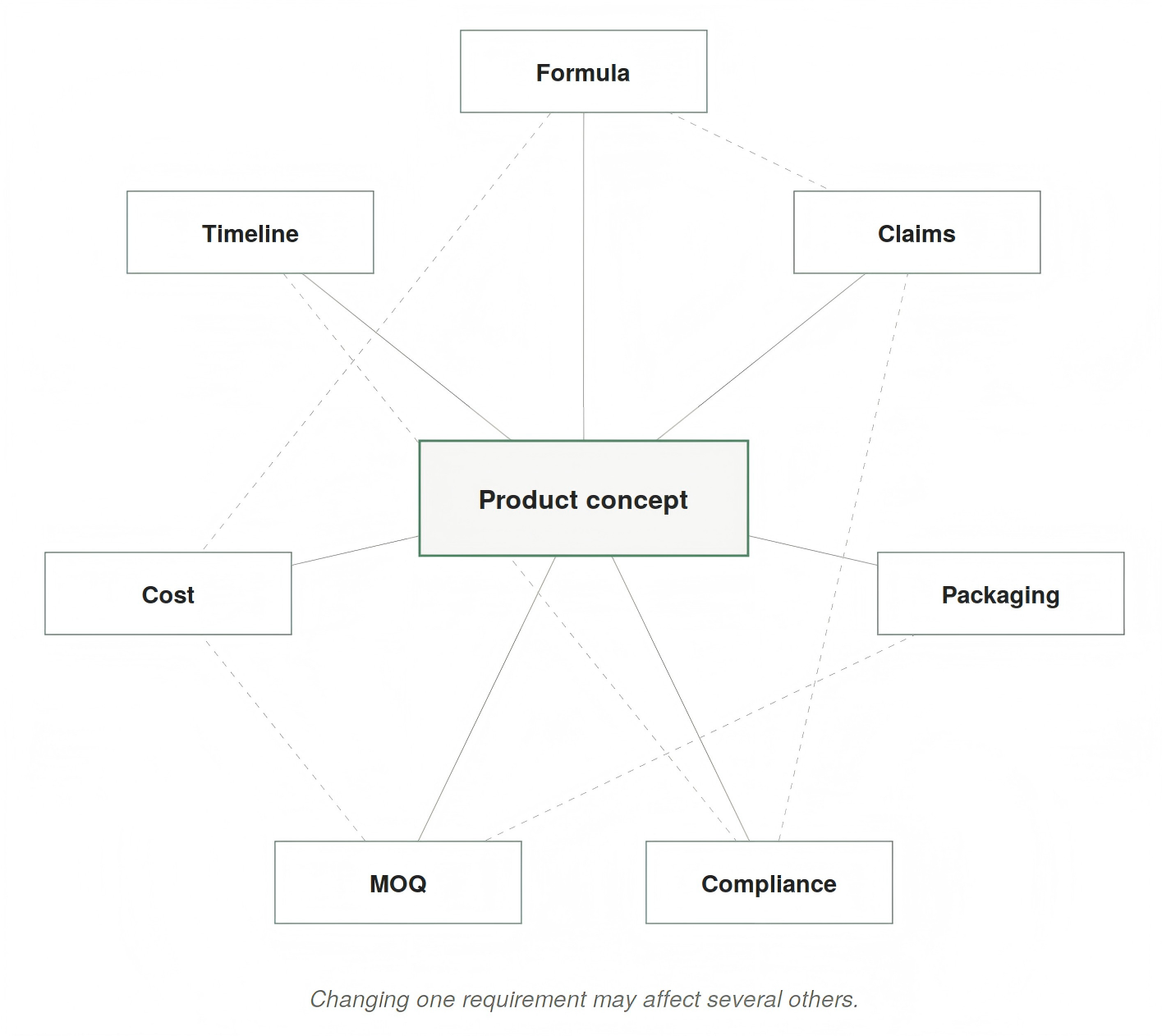
Formula, packaging, claims, target market, MOQ, cost, and timeline all pull on each other. Moving a project forward is really just taking all these open variables and closing them one at a time, in some order that actually works.
We did a project a while back for a European personal care brand. They came to us just looking for packaging — a custom bottle for a hyaluronic acid serum. Once we got talking, the project grew to include comparing two existing formulas, choosing between glass and plastic packaging, and later adding Vitamin C into the mix. From inquiry to shipping, the whole thing took about six months. First order: 2,000 pcs / 50ml.
That's pretty close to what real OEM development looks like. You don't need everything locked on day one — but the decisions that matter need to get made at the right time, not too early, not too late.
(More on how that project actually played out: From Packaging Request to Formulation Support.)
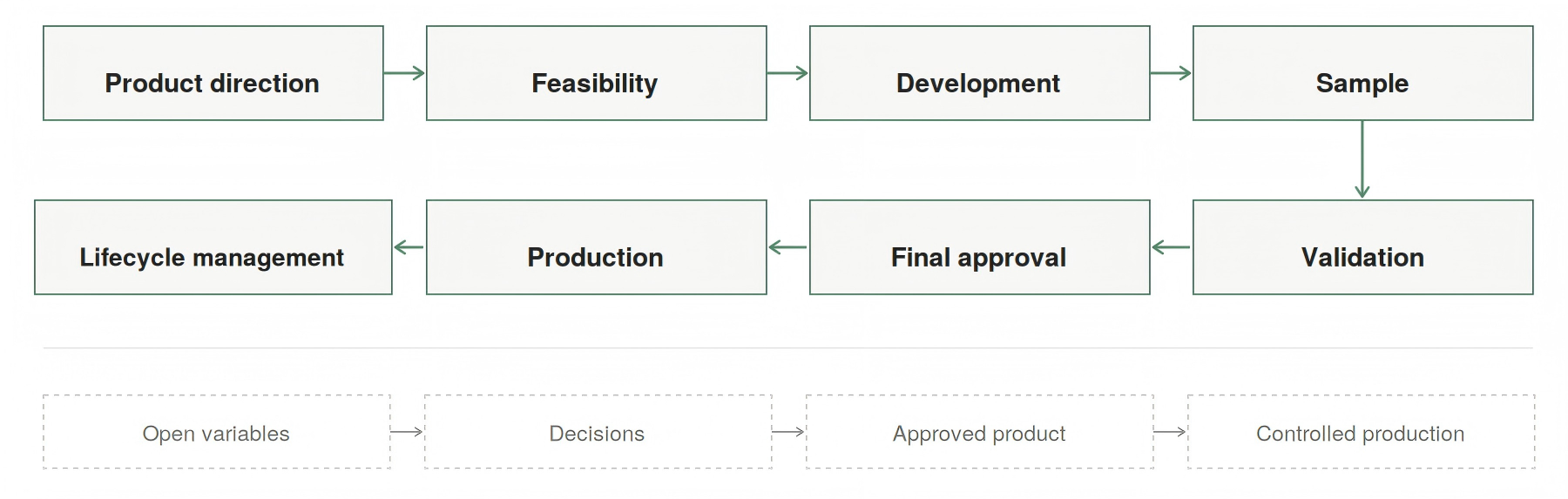
So let's walk through that process — how a product actually moves from a first idea to something you can manufacture commercially.
1. Start With the Product Direction
A complete product brief is great when you have one. Most projects don't start that way.
A client might know they want a sensitive-skin body wash, or that they're building out a spa and self-care line, without knowing yet what formula system to use, how much active ingredient to add, or what viscosity they're aiming for.
When that happens, we don't push a client to fill in every technical field before we start. We figure out the product direction first, and decide where to begin from there.
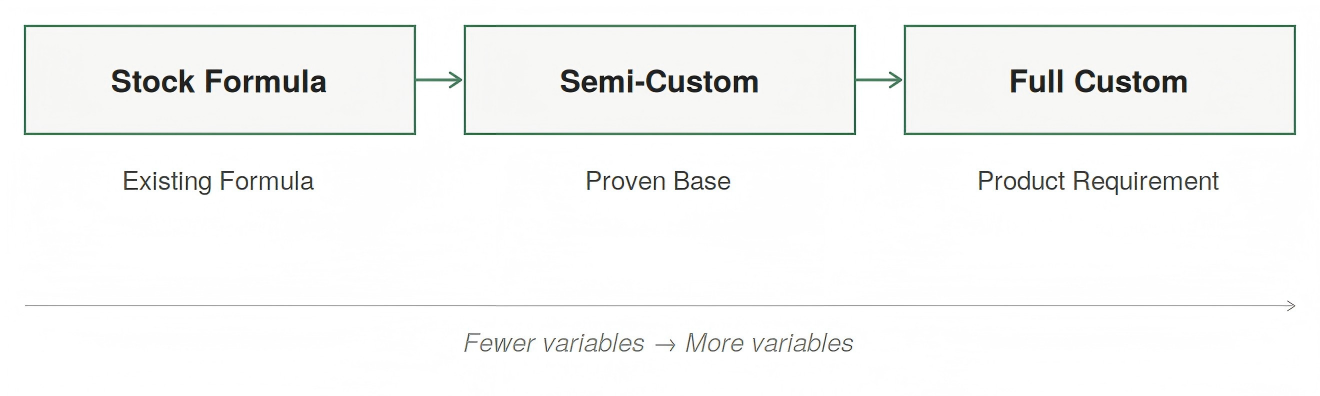
There are usually three starting points:
Stock Formula — start from a proven formula, use samples to confirm the general direction.
Semi-Custom — adjust actives, fragrance, color, viscosity, or specific performance on top of a proven system.
Full Custom — build from scratch around a clear benchmark, technical spec, or unusual product goal.
These aren't quality tiers. They're just different starting points.
A lot of the time, clients only really figure out what they want to adjust once they've seen the first sample. Sometimes the brief shapes the first sample. Sometimes the first sample is what finally makes the brief complete.
Occasionally the opposite happens, a client's first message already includes a full spec. That usually means the project is already fairly mature, sometimes already at the supplier-comparison or quoting stage.
So the real first step in an OEM project isn't get the complete brief. It's figuring out what the client has already decided, and what's still open. That's what tells us whether to recommend an existing option, move into formula development, or go straight to a feasibility check.
2. Check Feasibility Before Going Too Far
Once the direction is set, the next step isn't cramming every requirement into the formula. It's checking whether those requirements can actually coexist.
Take a 1,000-pc premium body wash: the client wants a naturally-derived surfactant base, a few active ingredients, a sensitive-skin positioning, plus a custom bottle color and a special pump.
Each of these is achievable on its own. Put together, problems show up.
A custom bottle color might need 5,000 pcs. A special pump might need 10,000. A more complex formula raises cost. Certain fragrances or actives can affect stability, claims, or testing requirements.
So what feasibility actually checks is whether this can all hold together at once:
Formula + Claims + Packaging + Compliance + MOQ + Cost + Timeline
Sometimes the answer isn't to drop the product concept, it's to change how it's delivered. Keep the core formula and positioning, use stock packaging for the first order, then move to full customization once volume grows.
The point of feasibility was never to tell a client what can't be done. It's to figure out which requirements have to stay, and which ones have room to flex.
3. Turn the Direction Into a Formula
Once the direction is set, formula development actually starts.
The important part here isn't adding every ingredient from the brief one by one, it's getting the finished product to actually perform the way the client wants. Cleansing power, foam, viscosity, skin feel, color, fragrance, stability, and the preservative system all interact, so what we're really confirming is the whole product, not any single ingredient.
Development usually runs as:
Prototype → Evaluate → Adjust → Confirm
Some requirements can be defined with a number, pH, viscosity, active level. Others can only really be judged by using the product, is the foam richer, does it feel too sticky, does it spread easily.
We won't get into formula systems or raw material selection here, that's covered properly in A Cosmetic Formula Is a System, and in How a Liquid Cosmetic Formula Becomes a Finished Product if you want to see the actual production-line steps.
4. Develop Formula and Packaging Together
While the formula is being developed, packaging is usually already moving too.
The two run as separate tracks, but they have to keep checking in with each other:
Formula Development and Packaging Development
Viscosity affects which pump or cap works. Oils, fragrance, and certain raw materials need to be checked against packaging compatibility. Packaging structure, in turn, affects filling and how the product actually gets used.
Packaging also has its own MOQ, its own sampling, its own procurement lead time, see our MOQ article for exactly where that number comes from.
In the hyaluronic acid project mentioned earlier, the client initially leaned toward glass, because it fit their idea of sustainability. But glass also means more weight, higher shipping cost, and more breakage risk. The client still chose glass in the end, but only after understanding what that choice actually cost them. So packaging was never just pick a bottle that looks nice at the end, it's part of product development, not an afterthought to it.

5. Use Samples to Make Decisions
A sample isn't there to be perfect on the first try. It's there to keep the project moving.
The first round might mostly confirm foam and skin feel. The next round fixes viscosity. The one after that locks fragrance or color. Each round should be solving one fairly specific problem.
Prototype → Evaluate → Decide → Revise
A good example of this is a project we did on a Malassezia-safe azelaic acid formula. When the client got samples back, the feedback wasn't a vague not quite right, it was specific: one version was too tacky and prone to flaking, another pilled and went oily when layered with a companion product. That kind of feedback is exactly what makes the next round of adjustment worth doing. Full write-up: From Gritty to Smooth.
So a development sample doesn't need to be flawless. It just needs to help us make the next decision.
Once formula, fragrance, color, packaging, and artwork are more or less locked, what a sample is for changes. At that point what's actually needed is a PPS, a Pre-Production Sample, something that represents what mass production will actually look like.
Development Sample asks: is this the right direction?
PPS says: this is the product we've approved.
The PPS, together with the approved formula, the written specification, artwork, and packaging standard, becomes what mass production is actually built on.
6. Test at the Right Time
Testing is part of development too, but it shouldn't all wait until the very end.
Test too early, and a formula or packaging change can make some results need re-checking. Test too late, and a stability, compatibility, or claim-substantiation problem can end up disrupting packaging that's already been ordered and a launch date that's already been set.
So the real skill isn't running more tests, it's timing them at the right point in development. We've covered the testing itself, what to test, how long it takes, what it costs, in Cosmetic Testing Before Production, so we won't repeat it here. And for anything on ingredient legality, claims, or documentation, that's the Cosmetic Compliance pillar, this section is just about timing, not the full compliance picture.
We ran into exactly this on a sunscreen project. Once the formula direction was confirmed, we scheduled ISO 24444 testing, took over a month end to end, and came back at SPF 42, short of the SPF 50 we'd originally been aiming for. Full case: From Ingredient Audit to SPF 42.
Which is the point, testing isn't a report you attach at the end. The result itself can change the formula, the claim, and the timeline, after the fact.
7. Final Approval and Production Release
Once formula, packaging, artwork, testing, and samples are all more or less locked, the project shifts from development into production.
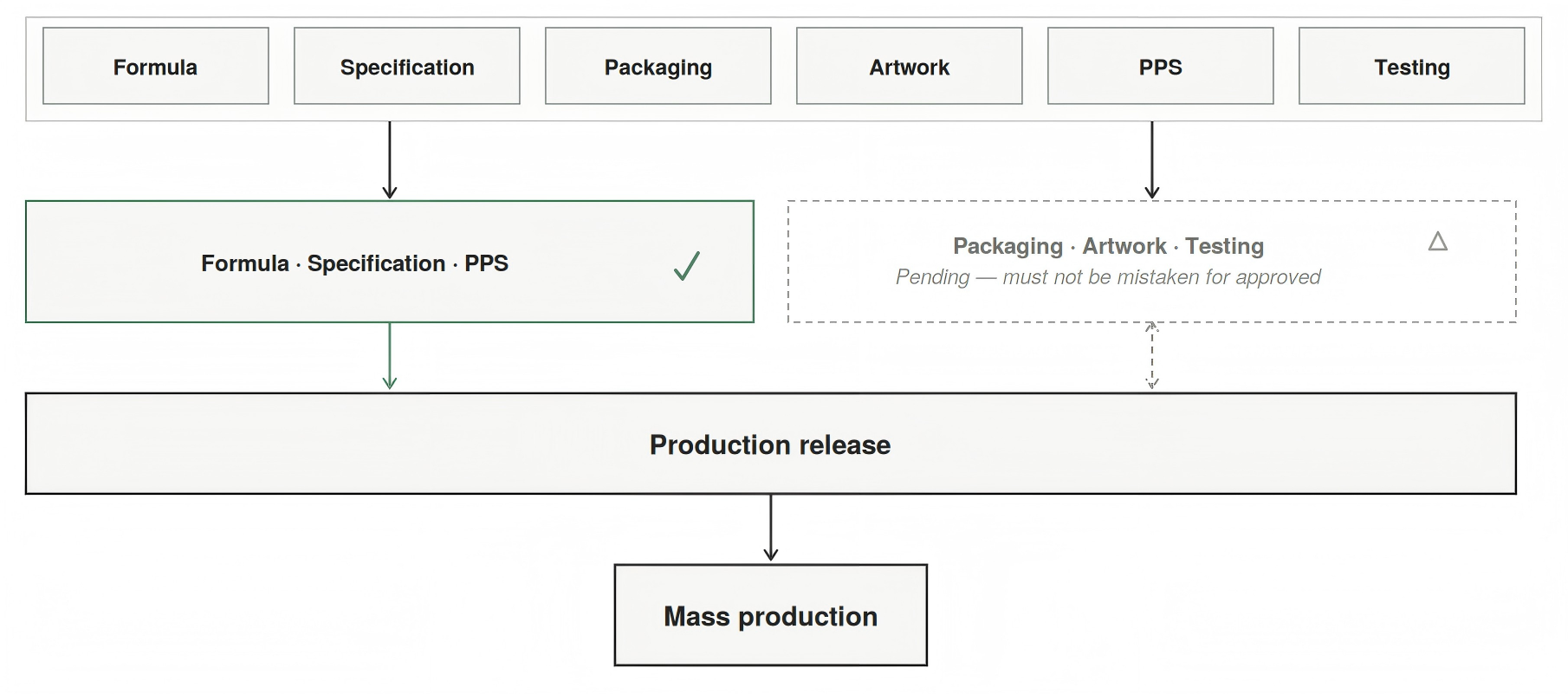
What this step really does is pull everything that's been confirmed separately into one clear basis for production:
Approved Formula + Specification + Packaging + Artwork + PPS + Order Requirements
The point isn't adding new requirements at this stage, it's confirming that every version actually matches. Does the final artwork correspond to the right packaging version? Does the order's fill quantity match the approved specification? Is production actually using the final formula version?
In real projects, not everything waits for the last test to finish before moving. To protect lead time, a PO sometimes gets confirmed, packaging procurement starts, even some production prep begins, while some validation is still pending. That's not necessarily a problem. What matters is being clear about which parts are Approved and which are still Pending, and what that Pending item could still affect.
Otherwise a project can look like it's already in production while a genuinely important variable is still open.
Once production is released, development is essentially done. From here, the job isn't changing the product anymore, it's producing the confirmed product consistently.
8. Mass Production and Quality Control
Development is about getting a product right. Mass production is about making that same product, reliably, over and over.
Once production starts, raw materials, packaging, compounding, filling, assembly, and packing all move through their own production and QC checkpoints.
What gets checked varies by product, but the principle stays the same:
Production Result vs Approved Standard
Mass production isn't the stage where you re-judge which product is better, it's confirming the actual output matches the formula, spec, PPS, artwork, and packaging standard that were already approved.
And QC can't all sit at the end. The earlier a first-article check, in-process check, or finished-goods check catches a deviation, the cheaper it usually is to fix. Find a problem only after the whole batch is done, and your options shrink to rework, sorting, or scrapping.
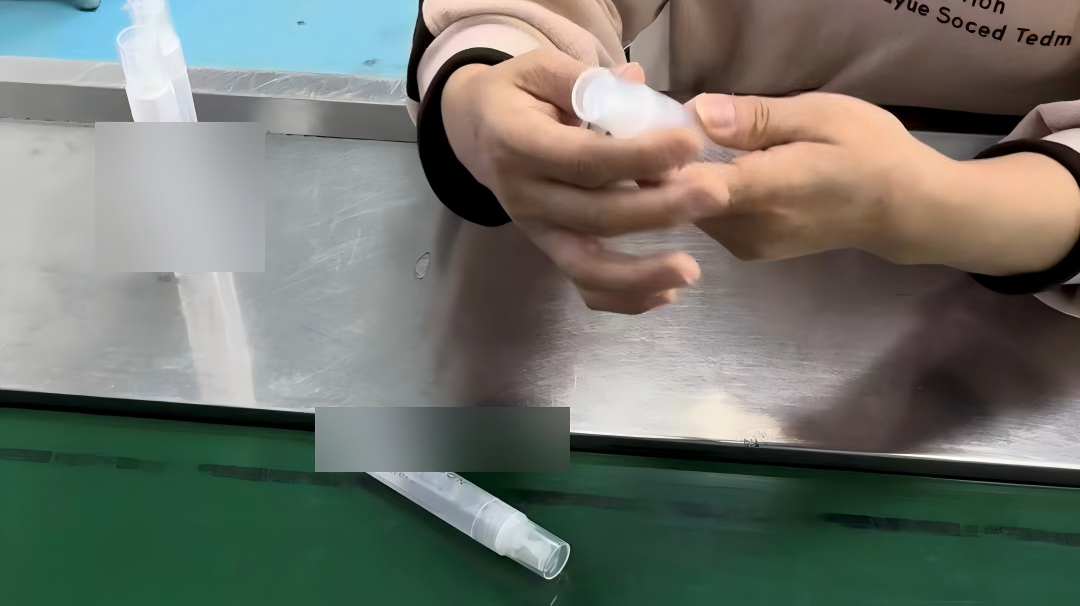
Once final inspection and shipping prep are done, the product genuinely enters commercial delivery. Logistics matters, but we won't get into it here, packaging, weight, shipping method, and destination are things that should already have been factored in back at the packaging development stage, not discussed for the first time once production is finished.
9. The Process Continues After Shipment
The first shipment isn't the end of a product's life.
A repeat order looks like just make it again, but given enough time, something always changes. A raw material supplier switches. A packaging component gets discontinued. Regulations get updated. The brand adjusts artwork, claims, fragrance, or some other detail.
So what long-term management actually has to answer is:
What changed? What does it affect? Does it need re-evaluation? What needs updating?
This is exactly the logic covered in more depth under Layer 8, Ongoing Compliance and Change Control, of our Compliance pillar, a supplier change, for instance, changing a raw material supplier, even when the INCI stays the same, still needs a judgment on whether the new spec, composition, or quality actually affects the existing product. How much verification or documentation update it needs depends on how much actually changed.
Market complaints and production feedback work the same way. They're not just an after-sales issue, they can just as easily be what pushes a specification, packaging, or production control update.
So a product that sells for years looks less like a one-time build and more like:
Produce → Monitor → Review Changes → Re-evaluate → Produce Again
The first development turns an idea into something you can manufacture. What comes after is keeping that same product running reliably while the supply chain, the regulations, and the market keep shifting underneath it.
Final Thought
Compress the whole thing down, and it's really just:
Direction → Feasibility → Development → Sample → Validation → Approval → Production → Lifecycle
Every step forward closes off a few of the variables that were still open.
OEM development was never about a client having everything figured out on day one, and it was never a factory that just starts producing the moment it gets a request either.
The more realistic version is: make the decisions that need making, when they need making, and don't lock in the things that still need testing before they're ready to be locked.
Do that, and a product idea that might have started as a couple of sentences eventually turns into something that can actually be manufactured, tested, delivered, and made again, reliably, the next time.
Have a product idea you're trying to work out? See how we approach OEM development, or get in touch to talk it through.
.jpeg)
