


Why "choosing a preservative" isn't as simple as picking one ingredient
In formulation conversations, we run into this a lot: quite a few clients, especially European ones, are reluctant to use phenoxyethanol and lean toward a sodium benzoate + potassium sorbate combination instead — the reasoning being that both are common in food, which feels "safer" or "more natural."
Behind that is a common misconception: judging whether a preservative is "good" based on its reputation and track record elsewhere — in food, say — rather than on whether it actually works under this specific formula's pH and target microbial risk.
The reality is that in today's US and European markets, phenoxyethanol has become the de facto default. Most formulators reach for it first, and only look for alternatives when there's a specific reason not to — a regulatory restriction, a client's marketing requirement, or pH incompatibility. That's not accidental, and it's not "everyone uses it so we do too" herd behavior. The reason is straightforward: every preservative has its own "capability boundary" — which microbes it's effective against (antimicrobial spectrum), and what pH range it can still work in (pH range). Phenoxyethanol became the default precisely because its performance on these two dimensions is more balanced, with fewer failure modes, than most other categories.
This article is about those two decisive variables: antimicrobial spectrum and pH range. Understanding them explains how phenoxyethanol got to where it is today — and helps you judge when it's actually worth considering something else.
What antimicrobial spectrum actually means
Antimicrobial spectrum, put simply, is which microbes a preservative can actually reach. Microorganisms fall roughly into four groups: Gram-positive bacteria (e.g., Staphylococcus aureus), Gram-negative bacteria (e.g., Pseudomonas aeruginosa, E. coli), yeast (e.g., Candida albicans), and mold (e.g., Aspergillus niger).
Few preservatives are equally effective against all four. Some work well against bacteria but barely touch mold or yeast; others are strong antifungals but under-cover Gram-negative bacteria. That's also why formulas often combine two or more preservatives — not to "add insurance," but to fill in the spectrum gaps.
This isn't just a general statement — minimum inhibitory concentration (MIC) data quantifies the difference. Take four common preservatives as an example: phenoxyethanol, butylparaben, Kathon (CMIT/MIT), and potassium sorbate. Kathon's MIC stays relatively low across all four microbial categories (150–600 ppm), making it the most evenly broad-spectrum of the four. Phenoxyethanol is the opposite — it needs a higher concentration across the board (2,000–5,000 ppm), especially against yeast and mold. Potassium sorbate is relatively sensitive against Gram-positive bacteria and mold, but its effective concentration against yeast is actually on the higher end of the four.

There's a point worth flagging here: "no growth during testing" doesn't mean the preservation system is actually adequate. A challenge test measures whether a product can suppress inoculated microbial contamination and keep it suppressed — that's the real evidence for whether spectrum coverage is genuinely adequate. We covered that testing logic in detail in How We Think About Preservation: A Multi-Hurdle Approach to Formulation Safety, so we won't repeat it here.
pH range: why the same preservative performs so differently across formulas
Antimicrobial spectrum decides who it can reach; pH range decides under what conditions it can still reach them.
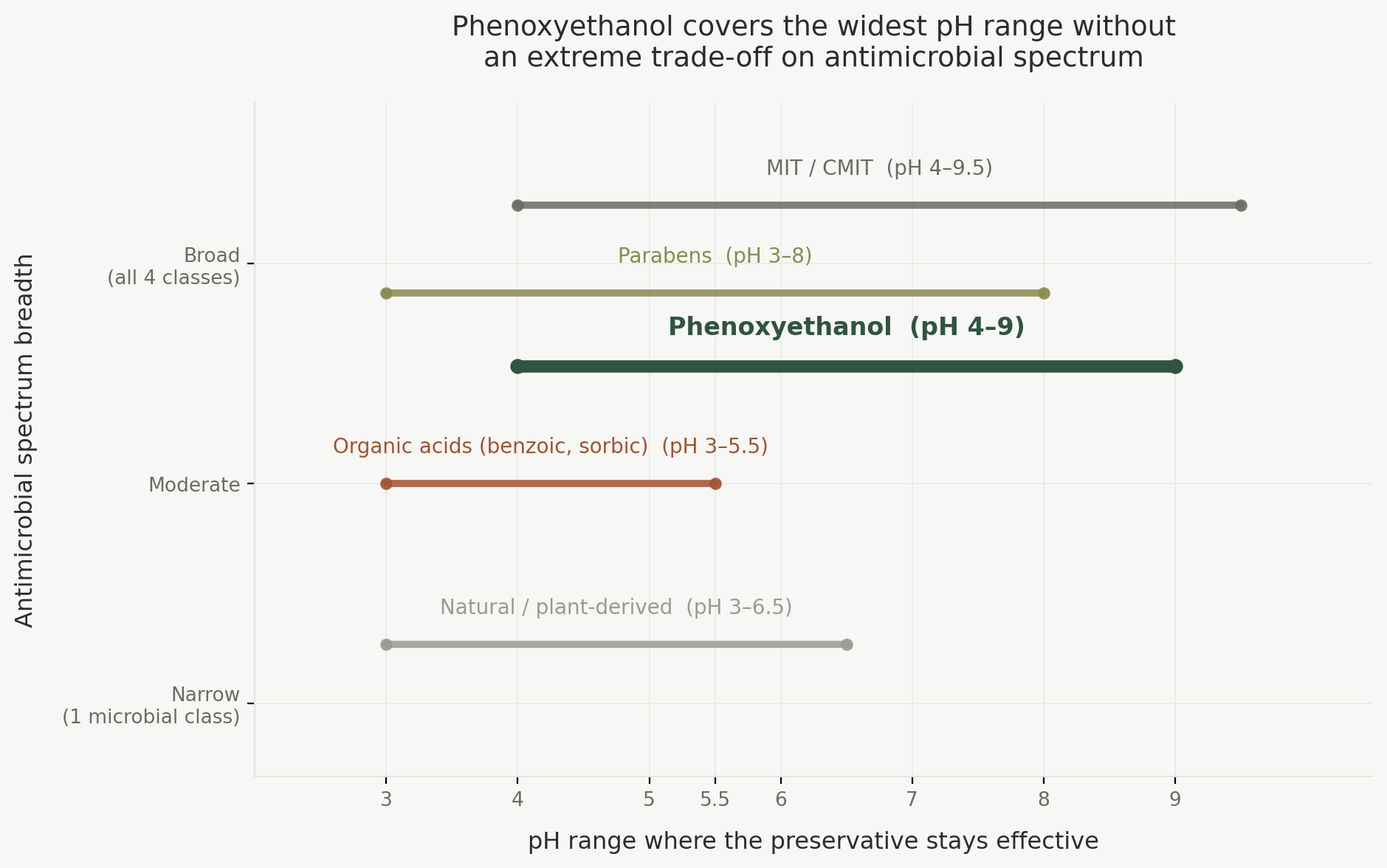
A classic example is organic acid preservatives like benzoic acid and sorbic acid. What actually inhibits microbes is the undissociated molecular form under acidic conditions — the molecular form can penetrate the microbial cell membrane, disrupt enzyme systems, and suppress cellular metabolism. As formula pH moves toward neutral or alkaline, the proportion of undissociated molecules drops, and so does preservative efficacy. These preservatives typically only hold an effective concentration below pH 5.5; once formula pH climbs higher, adding more doesn't help.
Phenoxyethanol and the isothiazolinones (MIT/CMIT) are comparatively less pH-sensitive, holding some efficacy across a wider pH range — though they're not without limits either.
A common failure mode we've seen: a client's formula is inherently alkaline (say, because a surfactant or functional ingredient needs an alkaline environment), but they've chosen a preservative that depends on acidic conditions to work. On paper, "a preservative was added" — in practice, it barely functions at that pH. Confirming the formula's pH range comes before choosing which preservative to use, not after.
Why phenoxyethanol is the default, and why the others are fading
The antimicrobial spectrum and pH range covered above are the two measuring sticks for understanding why phenoxyethanol has become the default choice across US and European markets today. This section walks through phenoxyethanol as the main thread, with the other categories as points of comparison — most remain legal to use, but their real-world share has clearly been shrinking, for different reasons: some from tightening regulation, some from consumer-perception pressure, and some because they were always narrow-use and never really became mainstream.
Phenoxyethanol — today's default choice. Chemically, it's a glycol ether, not a phenol — the phenolic hydroxyl on the benzene ring has already been etherified with a glycol group — but because of its high usage volume, regulatory attention, and distinctive antimicrobial behavior, the industry generally treats it as its own category rather than filing it under another chemical class. It became mainstream by not falling short on any front: reasonably broad spectrum covering bacteria and some fungi; stable across a wide pH range, unlike organic acids that get locked out by pH; and relatively stable regulatory status, without the ongoing tightening seen with MIT, parabens, or formaldehyde releasers. It's not the strongest on any single metric — but it has no obvious weak point, which is exactly why it became the default. It isn't universal either: used alone, it under-covers certain molds, so it's often paired with other preservatives (such as certain alcohols) in practice, with the exact combination depending on the formula system and target microbial risk — something we evaluate case by case.
The categories below have each been, or still are, used in specific scenarios — but none is the default direction in US/European markets anymore:
Parabens — technically sound, but pushed out by the "paraben-free" label. Relatively broad-spectrum antimicrobial activity, effective against most common contaminants, though weaker against Pseudomonas aeruginosa; suitable in environments below pH 8. On the regulatory side, the EU limits short-chain esters (methyl-, ethylparaben) to 0.4% for a single ester and 0.8% for ester mixtures; long-chain esters (propyl-, butylparaben and their salts) are capped more tightly at a combined 0.14% and banned in leave-on diaper-area products for children under three, under Commission Regulation (EU) No 1004/2014; isopropyl-, isobutyl-, phenyl-, benzyl-, and pentylparaben are fully banned, under Commission Regulation (EU) No 358/2014. What actually drives brands to avoid parabens, though, isn't regulation — short-chain esters remain legal today with generous limits — it's the marketing pressure from the consumer-facing "paraben-free" label. The "butylparaben" data point in the MIC chart above represents the long-chain esters in this category.
Isothiazolinones (MIT/CMIT) — regulation keeps tightening, use has been squeezed into rinse-off products. Strong broad-spectrum activity effective at very low concentrations, but regulation has tightened noticeably in recent years. Under EU Regulation 1003/2014, CMIT/MIT used as a 3:1 mixture is capped at 0.0015% (15 ppm) in rinse-off products. MIT used alone faces stricter limits: under EU Regulation 2016/1198, MIT is banned in leave-on products; under EU Regulation 2017/1224, MIT's limit in rinse-off products was also tightened to 0.0015%. These are two separate regulatory tracks that took effect at different times — worth keeping distinct in spec sheets and client communication. This ongoing tightening is the direct reason MIT/CMIT went from "once mainstream" to "now used cautiously, rinse-off only."
Formaldehyde releasers (e.g., DMDM Hydantoin, Quaternium-15) — some US states have begun systematic bans. Washington is currently the only US state with a systematic ban list: under the Toxic-Free Cosmetics Act (RCW 70A.560) (passed 2023), formaldehyde and formaldehyde releasers became prohibited intentional additives as of January 1, 2025; the Washington Department of Ecology's subsequent list of 25 restricted chemicals is being phased in across two batches, with the first already in effect since January 1, 2026, and the remainder taking effect January 1, 2027. California's and Maryland's bans are narrower, targeting only formaldehyde in hair-straightening products specifically. Confirmed: both DMDM Hydantoin and Quaternium-15 are on Washington's 25-chemical list (items 1 and 4 respectively), and both fall within the already-effective first batch — not the portion still pending until 2027. Projects targeting the US market involving these two ingredients need to be treated as already restricted, not "still under review."
Organic acids (benzoic acid, sorbic acid, and their salts) — still "mainstream" only within acidic systems. Effective only under acidic conditions, with a narrow pH range (typically requiring pH below 5.5); relatively effective against yeast and mold, with limited coverage against certain bacteria. The client request from the opening — replacing phenoxyethanol with sodium benzoate + potassium sorbate — is only genuinely viable when the formula itself is an acidic system (some AHA-based products, for example). Once the formula approaches neutral or alkaline, this combination is essentially decorative — which is the fundamental reason it never became a broad-spectrum default.
Alcohols/glycols (e.g., 1,2-hexanediol, pentylene glycol) — never an independent mainstream option. These have limited antimicrobial power on their own and function more as boosters or solubilizers — paired with a primary preservative, they can reduce how much of the primary preservative is needed, but they can't carry preservation on their own. This isn't a category in decline — it was never positioned as the primary defense to begin with.
Natural/plant-derived preservation systems — also never truly mainstream. Antimicrobial spectrum tends to be narrow and pH range more limited; rarely able to carry the full preservation load alone, usually requiring combination with other hurdles to reach equivalent efficacy. We cover the specific trade-offs and test data in more depth in How We Think About Preservation: A Multi-Hurdle Approach to Formulation Safety.
Regulatory limits at a glance
A regulatory limit is a ceiling, not a guarantee of efficacy — worth emphasizing on its own, since it's easy to mistake "under the limit" for "definitely working."
European Union. Cosmetics Regulation (EC) No 1223/2009 Annex V lists every approved preservative and its maximum concentration — a mandatory ceiling list for the EU market; anything over the limit can't be added.
United States. There's no mandatory preservative-limit list equivalent to the EU's Annex V — the US relies more on FDA's general safety requirements and industry self-assessment practices (CIR and SCCS opinions as reference points). That doesn't mean "no restrictions," though — Washington's formaldehyde-releaser ban, covered above, is a case of state-level legislation moving ahead of federal rules. Brands targeting the US market need to watch this kind of state-level activity.
China. China's Safety and Technical Standards for Cosmetics (2015 edition) also lists approved preservatives with maximum concentrations, following logic similar to the EU's Annex V — nothing outside the list may be used, and anything on the list must stay within its limit. A few examples: Kathon (methylchloroisothiazolinone and methylisothiazolinone, 3:1 mixture) is capped at 0.0015%, restricted to rinse-off products, and can't be used alongside MIT alone; benzoic acid and its salts are capped at 0.5% (as acid); sorbic acid and its salts at 0.6% (as acid); parabens at 0.4% for a single ester and 0.8% for mixed esters; phenoxyethanol at 1.0%. For brands serving both EU and Chinese markets, the two sets of limits don't always align, and the formula needs to be set to whichever is stricter.
The pH-range logic from the previous section applies here too: a regulatory ceiling only answers "is it allowed" — whether the preservative actually works in a given formula still depends on whether pH and spectrum match the product's real risk profile. These two questions get conflated often, but they're independent.
When it's worth considering something other than phenoxyethanol
Back to the question we opened with: a client wanting to replace phenoxyethanol with sodium benzoate + potassium sorbate because they're "common in food" isn't wrong to ask — it just requires answering a few questions about the formula first.
What's the formula's pH range? How high is the water activity? What's the main contamination risk, and which microbial category does it fall into? Is the packaging a wide-mouth jar or a pump? The answers determine whether an alternative is genuinely viable, or just looks safer on paper.
Phenoxyethanol became the default because it avoids trouble across most common formula conditions — but "default" doesn't mean "only option." An inherently acidic formula, a target market with marketing-driven concerns about a specific preservative class, or a product whose microbial risk concentrates exactly where phenoxyethanol is weaker — these are all legitimate reasons to consider an alternative or a combination approach.
This is also why we bring preservation system design into the conversation early in a project, rather than "adding a preservative" after the formula is already set. Preservation design is tied to the whole formula system — the earlier it's part of the discussion, the more room there is to adjust.
Want to see how we approach preservation and formulation as a whole? Learn more about our formulation approach.
References
[1] China's Safety and Technical Standards for Cosmetics (National Medical Products Administration) — list of approved preservatives and limits, cited in the China regulatory section.
[2] Qiu B. Cosmetic Chemistry and Process Technology [M]. Beijing: China Light Industry Press, 2006.
[3] Qiu B. Modern Cosmetic Science and Technology [M]. Beijing: China Light Industry Press, 2016.