
Most brand founders we work with have never seen the inside of a production line. They hand off a formula, and weeks or months later, a finished product arrives. What happens in between is usually a mystery, and most manufacturers don't explain it beyond "we have strict QC."
Here's what our line actually does, step by step, for a standard liquid cosmetic — a lotion, cream, or serum.
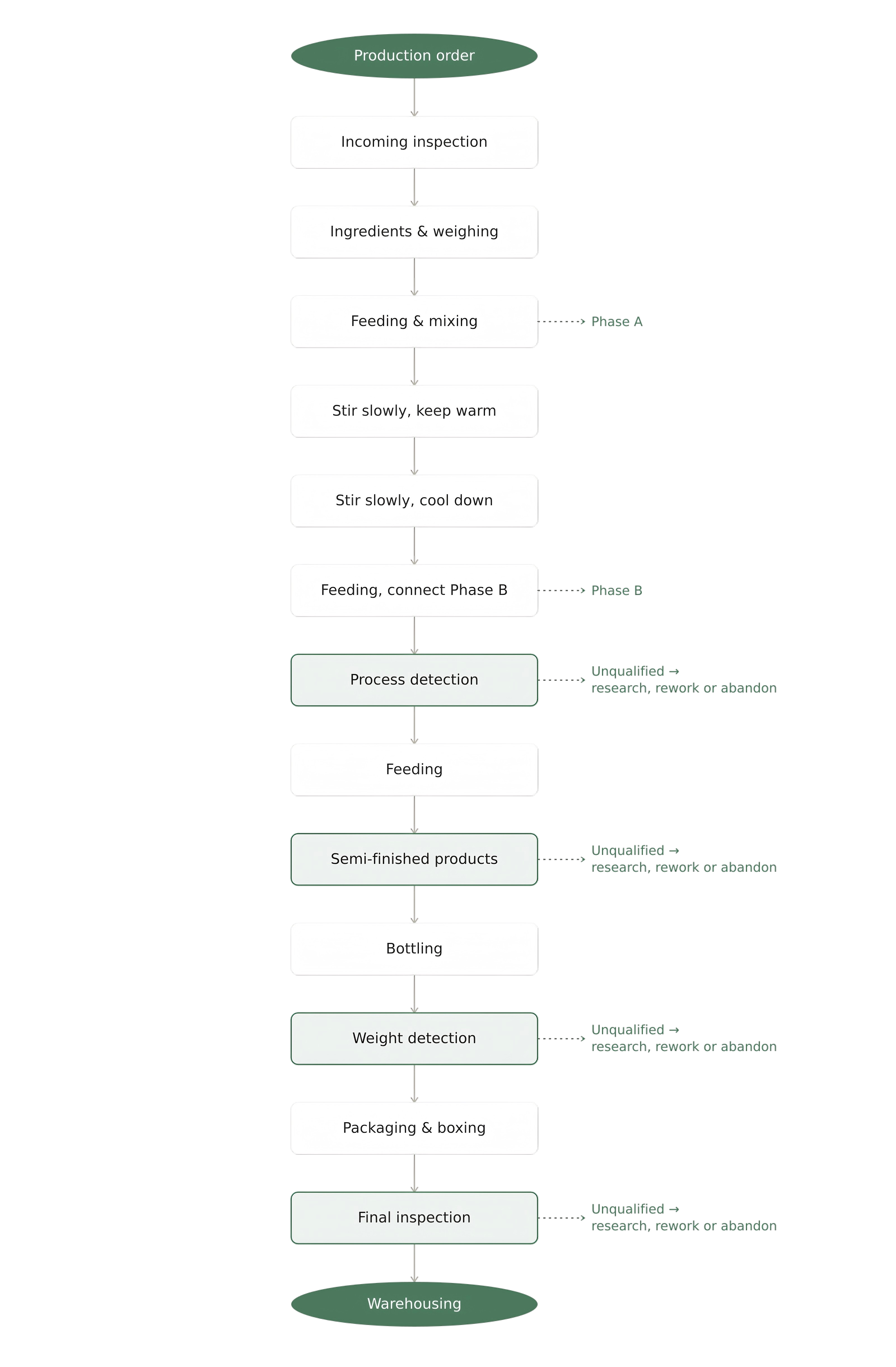
1. Production Order and Incoming Inspection
A batch starts with a production order tied to a specific formula and spec sheet. Before any raw material goes into a mixing tank, it's checked against supplier documentation and our internal specs — identity, appearance, and certificate of analysis where one applies.
Ingredients are then weighed out to the formula's exact ratios and logged against the bill of materials. This part isn't glamorous, but it's where a lot of downstream problems get prevented before they start.
2. Two-Phase Formulation
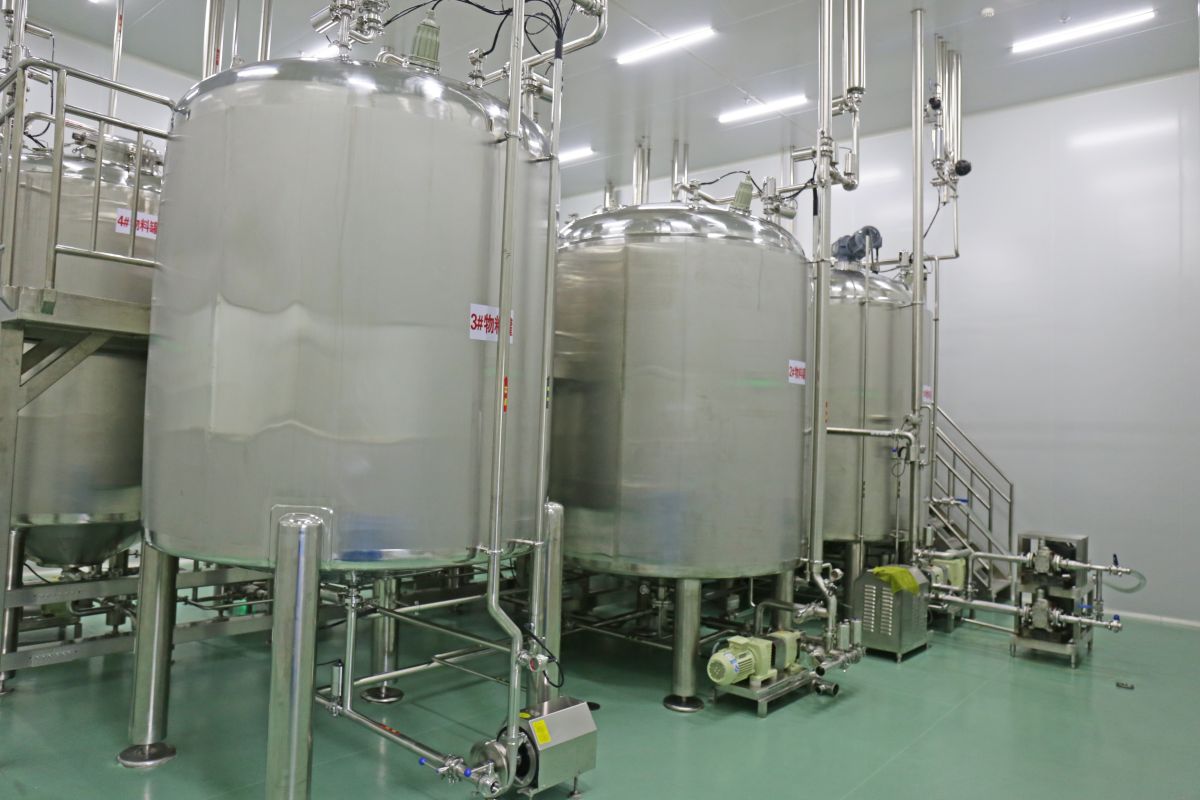
Something we explain to most first-time clients: a lotion or cream isn't mixed in one go. It's built as two separate phases — Phase A and Phase B — that come together partway through the process.
One phase typically carries the oil-soluble ingredients, the other the water-soluble ones. Each is heated and mixed on its own before the two are combined. This is the part of the process that determines whether an emulsion holds together or separates later — sometimes not immediately, but weeks into a stability test, which is a much worse time to find out.
The sequence we run looks roughly like this:
· Phase A and Phase B are each fed and mixed under controlled heating, typically in the 75–85°C range, with stirring speeds set separately for each phase — oil and water behave differently under agitation, so they're not treated the same way.
· Once combined, the batch is held warm and stirred slowly, then brought down through a controlled cooling stage (around 35–40°C) rather than cooled quickly, which is what tends to cause instability.
· Heat-sensitive ingredients — actives, fragrance, some preservatives — go in during this cool-down stage, once the batch has dropped to a safe temperature, and get connected back into Phase B.
Every one of these steps runs on defined temperature ranges and stirring speeds, tracked for each batch. It's more steps than people expect for "mixing a lotion," but this is genuinely where emulsion stability is decided.
3. Process Detection
Before the batch moves on, it goes through process detection — a check on appearance, aroma, and pH.
This is a gate, not a formality. A batch that doesn't pass goes to our research step, where we work out what went wrong. If it's something we can correct, we rework the batch and re-test it. If not, it's abandoned rather than pushed forward. We don't publish how often that happens, but it does happen, and we'd rather catch it here than have a client find out later.
4. Feeding and Semi-Finished Product Testing
Once a batch clears process detection, it's discharged under controlled pressure — enough to move it forward without introducing air or shear damage — and becomes what we classify as a semi-finished product.
At this stage we test for:
· Appearance, color, aroma, pH
· Cold and heat resistance
· Total effective substance content, to confirm actives are actually present at the intended concentration
· Foam height, for cleansing formulas
· Colony count
Same rule as before: anything that doesn't clear this moves to research, and from there either gets reworked or abandoned. Only what passes goes to bottling.
5. Bottling, Weight Detection, and Packaging
Qualified semi-finished product is bottled, then checked at weight detection — confirming each unit is filled to spec. Underfilled units are a compliance problem; overfilled ones tend to leak or damage packaging during shipping.
From there it moves to packaging and boxing. Anything that fails weight detection goes back through the same research and rework process — reaching this stage doesn't exempt a batch from failing.
6. Final Inspection
Before anything reaches the warehouse, it goes through final inspection, which is the most complete check in the process:
· Appearance, color, aroma, pH
· Cold and heat resistance
· Total effective substance content
· Foam height
· Colony count, plus mold and yeast count specifically
· Net content
· Label accuracy
· Outer package condition
This is the point where microbiological safety, labeling, and packaging all get confirmed together, before anything ships. Only product that clears every item here goes to warehousing — everything else loops back through research.
Why We Walk Clients Through This
None of this is unusual for a properly run line — it's the kind of checkpoint-driven structure ISO 22716, the cosmetics GMP standard, expects a manufacturer to follow. We're not describing it because it's rare — we're describing it because most manufacturers don't explain it, and we think brands evaluating a production partner should know what to actually ask about.
A few questions worth asking any manufacturer:
· How many checkpoints exist between raw material and finished product, not just at the end?
· What happens to a batch that fails one of them — is there a documented process, or does it just get pushed forward?
· Is testing done on semi-finished product, or only at final inspection?
· Does microbial testing cover mold and yeast specifically, or just a general colony count?
This is roughly how we'd answer those questions about our own line. It's a fair basis for comparing against anyone else's.
Enrich Lab develops and manufactures liquid cosmetic formulations — lotions, serums, and creams — for indie and emerging brands in the US and EU, with full production documentation and compliance support at every stage. See how our process works →